
The practical answer
Choose Mlinčići for a focused watermill and heritage stop; choose a named Pliva lakeside area for a slower landscape outing. They are beyond Jajce’s central waterfall and need their own approach and return. Keep children close to flowing water, use open paths and treat swimming or boat hire as separately checked activities.
Compare the options
| Decision | Watermills | Lakeside outing |
|---|---|---|
| What you come to see | A cluster of historic, real wooden watermills and the flowing tufa-divide setting. | Views of the Great or Small Pliva Lake and time beside a broader landscape. |
| Where it is | On the barrier between the lakes, away from the central town waterfall. | Around the two Pliva Lakes, described by Jajce's heritage agency as about five kilometres from town. |
| Walking expectations | A shorter, place-focused outdoor visit where bridges, steps, wet rock and crowds still need current checking. | Time to choose an appropriate waterfront section, not an assumed continuous accessible trail all around the lakes. |
| With young children | Keep children close to flowing water, tufa edges and any unguarded sections; do not let them approach machinery. | Enjoy views from verified safe public areas. A lakeside photo does not establish shallow water or supervision. |
| Water activities | The mill channel is a heritage location; do not treat it as a canoe launch or swim entrance. | Kayak, paddle boat, canoe, fishing or swimming only after checking the actual permitted, currently supervised or operator-run arrangements. |
| Bad weather | Wet or icy surfaces and river levels may affect a viewing approach; the mills do not justify risky edge access. | Wind, cold, lightning, water temperature and uneven shoreline can make a land-based outing preferable. |
Start with the Mlinčići watermills
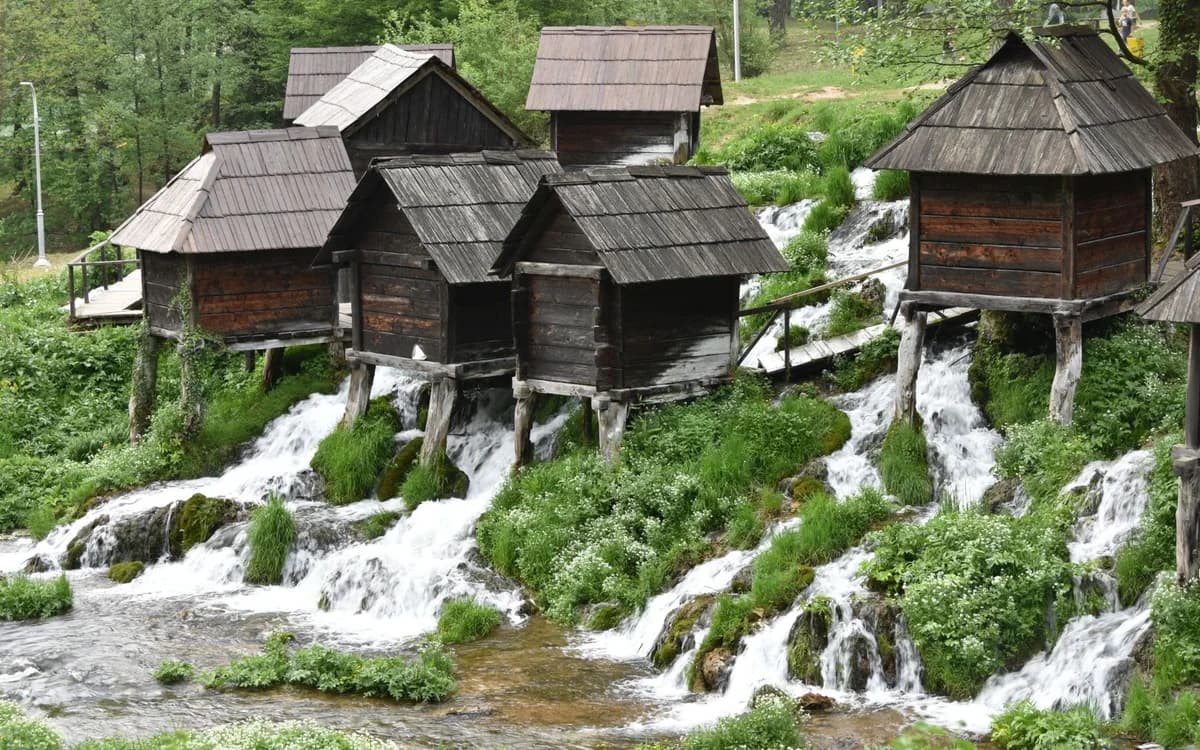
Start at Mlinčići if the little wooden mills are what drew you to the lakes. The local heritage agency places them on the tufa barrier between the Great and Small Pliva Lakes: a useful clue to why so much water runs among the buildings. Look at the channels and mill structures as well as the familiar roofline. Use the designated viewing and walking areas, and check the approach if steps or uneven ground are a concern for your group.
Give the Great and Small Pliva Lakes time

Photo credit
“Plivske jezero u Jajcu” — Martin Brož · Wikimedia Commons · CC BY 3.0 · Cropped to a 16:10 editorial frame, resized to 1200×750 and converted to WebP for local web delivery.Choose the lakeside when you want the wider water-and-woodland landscape. It gives the day a slower rhythm than the historic centre: pick a public access point, leave time to pause and let the mills be one part of the outing. The local heritage agency describes canoeing and kayaking around the lakes; arrange any activity separately with a current provider rather than assuming equipment will be available when you arrive.
How the river shaped the mills and lakes
The Pliva is not just the waterfall at Jajce's historic centre. Before the river reaches the town and joins the Vrbas, its flow spreads into two neighboring lakes, commonly called Veliko and Malo Plivsko jezero. The local cultural and natural heritage agency identifies a tufa partition between them. Tufa is a rock formed by mineral deposits in flowing water; over long periods, these natural barriers shape cascades and channel changes. The wooden Mlinčići are set in this moving-water landscape. Seeing them in context is more rewarding than photographing a row of tiny roofs without understanding why water runs among the structures.
The mills tell a human history alongside the geological one. Before modern mechanical milling, a water-powered mill brought local grain and a river's energy together. The Jajce municipality explicitly lists its Pliva watermills as part of the town's tourist heritage, while the heritage agency describes the lake setting as a nature-and-recreation landscape. That does not mean every mill is a museum or safe to enter, or that all old mill mechanisms remain in operation. Respect any closure and read the external form as part of the site. Take photographs from the designated viewing area rather than stepping onto unstable tufa or blocking local access.
- Treat Mlinčići as historical structures in a living watercourse, not interactive playground equipment.
- Do not assume an open door permits entering a watermill or that all timber bridges are step-free.
- Use the river's two-lake geography to understand why the mills are here, but don't improvise a bank shortcut.
A family outing beside the water
The authority's Pliva Lakes page names recreation and kayaking, reflecting a long local relationship between the water and outdoor sport. That is a description of possibilities within the region, not a declaration that every shore permits swimming or that a licensed kayak operator will be open on your chosen afternoon. Before choosing a craft, find the actual current provider and launch site, confirm that its operation is permitted, and check suitable equipment, age requirements, supervision and rescue arrangements. No specific kayak departure, rental inventory, boat price, swimming zone, lifeguard or water condition has been verified for this guide.
A sensible family default is a shoreline viewpoint and a meal or rest away from the water's edge. Moving water, a tufa partition, hidden uneven surfaces and changing weather are reasons to stay away from drop-offs with children. Even familiar-looking lakes are not automatically safe for swimming: cold water, fishing activity, storms or seasonal closures can change the decision. If there are heavy winds, thunder, flooding, ice or signage closing an area, treat that as a reason to change or shorten the outing. A kayak advertised in a historic tourism brochure is no substitute for a current provider confirmation.
- Never infer safe swimming, depth or water temperature from a photo or an old tourism description.
- For a guided/paid water activity, verify its licensed operator, current offer and fitting safety equipment.
- Keep minors beside you at moving water, mill channels and exposed shoreline.
Town day or lake day?
Jajce's waterfall is in the historic settlement; Mlinčići and the lakes are a separate site about five kilometres outside the town according to the public heritage agency. Five kilometres on a map is not a promise of a flat, signed or continuously usable sidewalk, nor does it establish a public bus or safe evening walk. Start with your hotel or real town base, confirm the exact park or lakeside point you want to visit, and establish how you will get there and back. The independent tourist guide's example programme explicitly uses transport between the central historic sights and the lakes, but its programme is not a public timetable or a transferable booking promise.
Build a trip around actual energy and mobility needs rather than a dense list of attractions. Jajce's fortress approaches include steep historic streets; the lake area is a different landscape with its own uneven banks and crossings. Anyone requiring step-free travel, a stroller-friendly approach or accessible restrooms should confirm the precise viewing access and facilities, not rely on a general 'family-friendly' description. Surface conditions, snow, winter ice, storms or temporary road works can affect even short transfers, so avoid invented driving minutes and check what will work at the date and hour you travel.
- Do not mix the town waterfall and the lake into one automatically walkable site.
- Confirm the exact public viewing/access point and your round-trip transport, not a generic lake search pin.
- Ask directly about strollers, wheelchairs, restrooms, steps and railings as needed.
Where to base yourself
Choose the base that makes the next morning easier. Use the destination guide for the location trade-offs, then compare individual stays and confirm the actual journey to the attraction.
Questions that help you plan
Are the Pliva Lakes next to Jajce waterfall?
No. The waterfall sits in central Jajce where the Pliva reaches the Vrbas, while the local heritage agency places the Great and Small Pliva Lakes roughly five kilometres away. Mlinčići is between the two lakes. Plan an actual transfer rather than a guaranteed flat walk.
What are Mlinčići?
They are historic small wooden watermills on the Pliva's tufa partition between the Great and Small Lakes. See the structures and the surrounding moving water from authorized viewing access; do not assume the interiors are open.
Should we choose watermills or the lakes with children?
If you want one compact heritage-photo subject, prioritize Mlinčići. If you have flexible time for landscape, include the lakeside from a verified safe public access point. For either option supervise children closely near flowing water and uneven banks.
Can I swim in the Pliva Lakes?
Regional tourism sources mention swimming and boating as activities, but this guide has not verified a designated safe swimming zone, water temperature, supervision or rules for your date. Never treat that background mention as permission to swim.
Are kayaking and canoeing bookable now?
No availability has been checked or booked. The Jajce agency discusses the lake's history of kayaking and competition; a real future activity needs a current, authorized provider, exact launch point, age/equipment rules and water/weather assessment.
Can I do everything on foot from a Jajce hotel?
Some central town sights can be connected on foot, depending on terrain, but the lake/watermill region is a separate geography. Confirm a realistic transfer or actual route for your group; do not infer accessible walking from the town name.
Will the mills and lakes work in winter or after heavy rain?
Seasonal surface conditions, water levels, wind, ice, temporary site closures and available transport all require current checking. Opt for safe visible public areas or change plans rather than approaching tufa and swift-water edges.
Where should I sleep for a Pliva Lakes day?
Jajce is the existing reviewed town base; use its destination and vetted stay-search pages to choose a real property. Staying in the town does not include lakeside transport, an activity reservation or lake access conditions.
Sources and further reading
Operator and heritage references support the descriptions; our existing guides provide additional context. Opening, admission, transport and seasonal services can change. Check with the responsible operator for your travel date. Images carry separate credits.
- Jajce public heritage agency — Great and Small Pliva Lakes and historic mills Source reviewed 2026-10-15
- Jajce public heritage agency — Mlinčići and their tufa-barrier setting Source reviewed 2026-10-15
- Jajce municipality — town waterfall, Pliva Lakes and watermills listings Source reviewed 2026-10-15
- Jajce heritage agency — broader visitor service and contact information Source reviewed 2026-10-15
- Independent Jajce tourist guide — monuments, waterfall and watermills Source reviewed 2026-10-15
- Independent Jajce tourist guide — example multi-stop programme, not a guaranteed booking Source reviewed 2026-10-15
- nEUlakes / partner Agency Jajce — landscape, conservation and cultural value Source reviewed 2026-10-15