

The practical answer
Choose the National Museum for archaeology, ethnology and natural history across centuries. Choose the War Childhood Museum for objects and personal accounts of childhood affected by war. They have different addresses, tickets and visiting rhythms. Check Haggadah arrangements at the National Museum and current access at either institution rather than squeezing both into one interchangeable stop.
Compare the options
| Decision | National Museum: objects across centuries | War Childhood Museum: testimonies and personal objects |
|---|---|---|
| Core subject | Archaeology, ethnology, natural history and long-term cultural collections | Lived childhood experience in armed conflict, personal belongings and contributors' stories |
| Actual location | Zmaja od Bosne 3, broader central city | Logavina 32, historic city centre |
| Exhibition rhythm | Several permanent collection areas and changing exhibitions | Periodically rotated personal-object and testimony displays |
| Planning question | Which departments or Haggadah access arrangement will be offered? | Is your party ready for difficult testimony and what age-appropriate support is offered? |
| Current access concern | Official ticket page distinguishes regular scheduled Haggadah viewing from advance-booked curator visits; check the day | Confirm the current step-free entrance and lift arrangements with the institution |
| Photography | Parts of the Museum restrict photography; ask onsite, do not assume permission | Respect the contributors and display rules; no objects or testimonies republished here |
The War Childhood Museum’s visitor page carried a temporary lift-outage notice when checked on 15 October 2026. Contact the museum before relying on lift access. Sarajevo Haggadah viewing at the National Museum has separate arrangements from ordinary admission.
National Museum: objects across centuries
The National Museum's archaeology, ethnology and natural sciences collections cover a far wider period than the siege of Sarajevo. Its prehistoric and nineteenth-century urban-life exhibitions require time to absorb objects, display labels and multiple departments. Its original Sarajevo Haggadah room has separate controlled access: never assume a regular ticket guarantees an unplanned viewing. The National Museum is at Zmaja od Bosne 3, away from Baščaršija's narrow lanes.
War Childhood Museum: testimonies and personal objects

Photo credit
“War Childhood Museum Sarajevo” — Hibasi · Wikimedia Commons · CC BY-SA 4.0 · Cropped to a 16:10 editorial frame, resized to 1200×750 and converted to WebP for local web delivery.The War Childhood Museum's permanent exhibition opened in 2017 and periodically changes which contributor stories and possessions are displayed. A small object can carry a very large, sometimes painful account. Reading these accounts is not the same as a conventional chronological military-history gallery. The institution is on Logavina 32; its own site describes educational programmes and reflection spaces, with visitor conditions that change separately from those of the National Museum.
Make time for the National Museum’s collections
Founded in 1888, the National Museum is an institution for the natural and human history of Bosnia and Herzegovina. The archaeology department includes prehistory, classical antiquity and the medieval period; its ethnology department preserves clothing, domestic objects and cultural practices; the natural sciences collections include geology, zoology and botany. These are separate kinds of learning. A visitor who enjoys material culture may be more satisfied with a selected department explored carefully than racing from one building to another to claim the whole museum.
The Museum describes its prehistory exhibition, reopened in 2021 after decades, as a selected survey of objects from a much larger research collection. Its eighteenth- and nineteenth-century townhouse interiors present domestic life in six rooms. On 15 October 2026, the Museum's detailed official ticket page describes regular viewing of the original Sarajevo Haggadah at specific stated hours with an ordinary museum ticket, as well as separately arranged curator visits requiring advance booking. A standard ticket does not mean the manuscript room is open whenever a visitor arrives. The general visitor-information page and detailed ticket page now agree on the ordinary adult admission amount; neither should be treated as a permanently fixed tariff. Check the detailed current ticket page again on the actual travel date.
- Choose a department and exhibition before setting aside the afternoon; not all collection rooms have the same focus.
- Check the detailed official ticket page for regular Haggadah viewing slots versus advance-booked curator visits, and recheck prices.
Listening closely at the War Childhood Museum
The War Childhood Museum was founded around the accounts and personal belongings of people who grew up during conflict. Its own permanent-exhibition description explains that it selects and periodically rotates contributor stories, conveying experiences of play, displacement, fear, loss and resilience without pretending there was one universal childhood. The items are meaningful because they belong to real contributors. Avoid inventing a survivor's words from a display, photographing people without consent or describing the material as entertainment that every family should tolerate.
Its visitor information includes thoughtful educational material for different age groups and specific access arrangements. Ask the museum about current lift access and a suitable entrance before travelling. For a child or person affected by trauma, letting them choose whether to enter and how long to stay can matter more than seeing every object. A family group should read the institution's own visiting-with-children guidance rather than assuming there is a universal minimum appropriate age.
- Read the Museum's own exhibition/visitor guidance and select whether the subject fits your party's emotional readiness.
- Ask the museum about its current entrance, lift and accessible-route arrangements.
Where to stay in Sarajevo
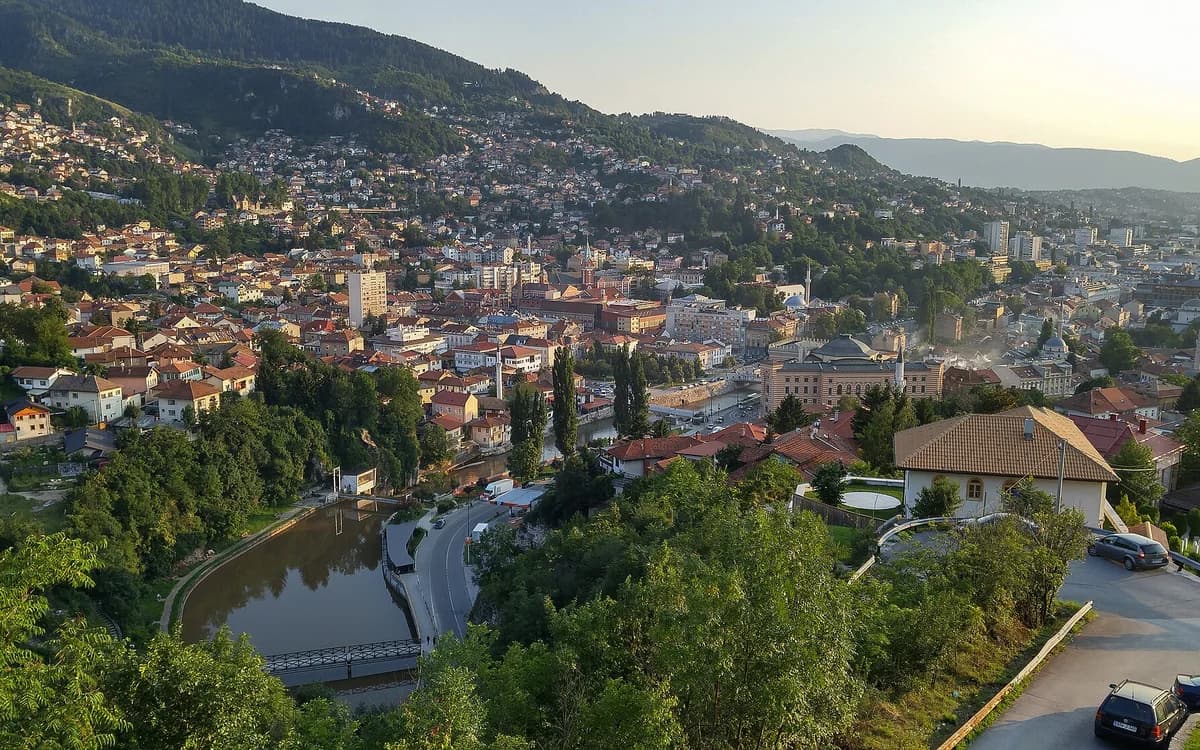
Photo credit
“A view of Sarajevo from the Yellow Fortress” — Skelanard · Wikimedia Commons · CC BY-SA 4.0 · Cropped to a 16:10 editorial frame, resized to 1200×750 and converted to WebP for local web delivery.The two institutions are in different parts of central Sarajevo. Choose your accommodation for the city itinerary and verified public transport, not for an invented joint museum-ticket package. The site's existing Sarajevo planning and stay searches remain the public owners of neighbourhood and hotel decisions.
Where to base yourself
Choose the base that makes the next morning easier. Use the destination guide for the location trade-offs, then compare individual stays and confirm the actual journey to the attraction.
Questions that help you plan
Is the War Childhood Museum a section of the National Museum?
No. They are independent museums at different Sarajevo addresses, with different collections and separate visitor arrangements.
Can I see the original Sarajevo Haggadah on an ordinary walk-in ticket?
The National Museum's detailed ticket page currently lists regular viewing slots with ordinary admission on selected days, not unrestricted walk-in access at any hour. Curator-led special visits have separate booking conditions. Confirm the schedule and eligibility for your date.
Which is better for children?
It depends on the child and the experience you want. The National Museum spans natural history, archaeology and culture; the War Childhood Museum has age-specific educational resources but contains serious testimony. Read the museums' own child and content guidance.
Are both museums wheelchair-accessible?
The War Childhood Museum describes accessible galleries and facilities, but its visitor page also carried a temporary lift-outage notice on 15 October 2026. Ask about current entrance and lift arrangements before arrival. Contact the National Museum separately about the galleries and assistance you need.
How much do tickets cost right now?
As checked on 15 October 2026, the National Museum's general visitor-information page and detailed price list agree on the ordinary adult ticket amount, but special Haggadah and guided visits have different conditions. The War Childhood Museum has its own pricing. Check both official sites for your exact date before buying.
Sources and further reading
Operator and heritage references support the descriptions; our existing guides provide additional context. Opening, admission, transport and seasonal services can change. Check with the responsible operator for your travel date. Images carry separate credits.
- National Museum — current visitor information Source reviewed 2026-10-15
- National Museum — current ticket categories and Haggadah room Source reviewed 2026-10-15
- National Museum — departmental collection overview Source reviewed 2026-10-15
- National Museum — prehistoric permanent exhibition Source reviewed 2026-10-15
- War Childhood Museum — permanent Sarajevo exhibition Source reviewed 2026-10-15
- War Childhood Museum — visitor and accessible-entry information Source reviewed 2026-10-15