
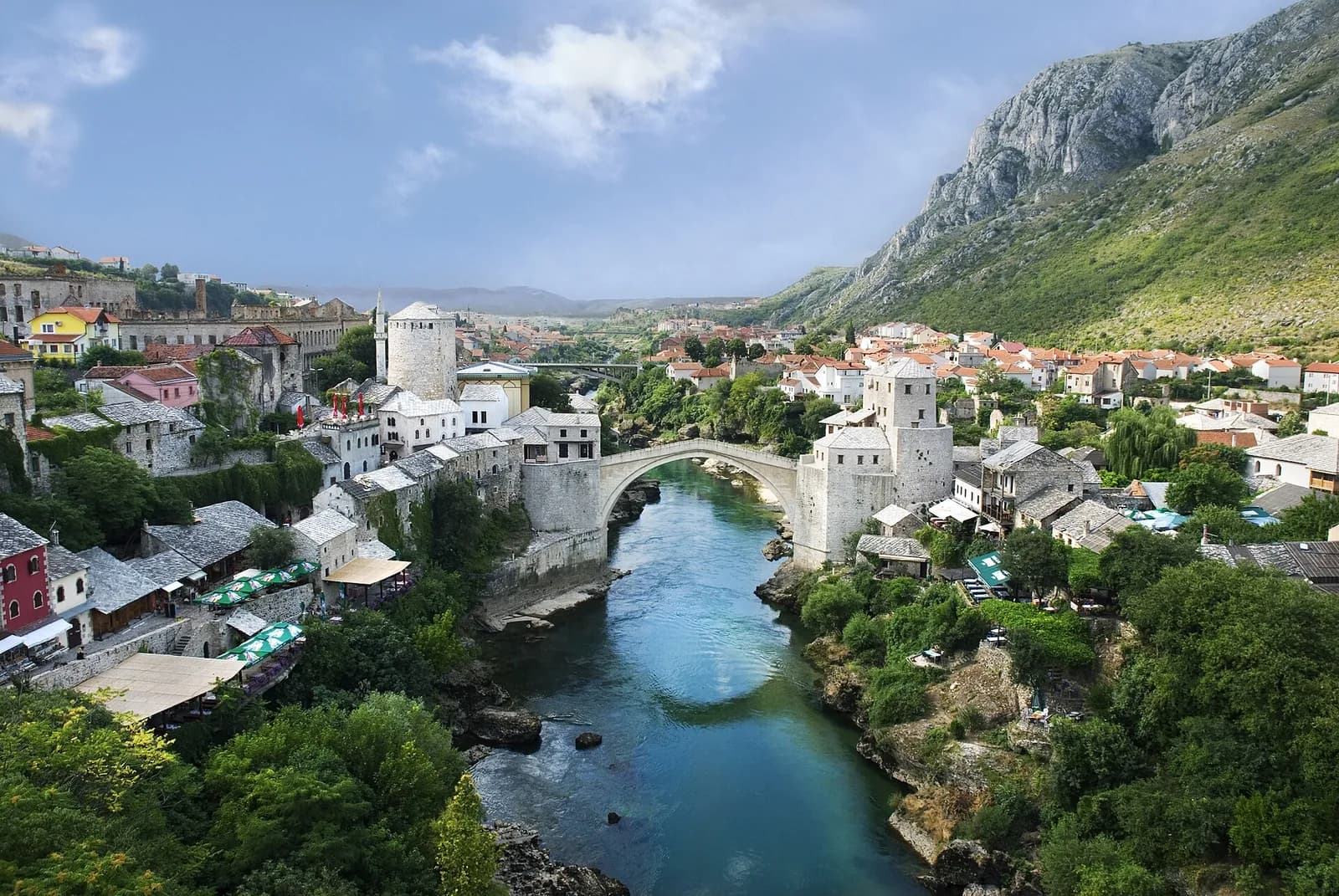
The practical answer
Mostar and Višegrad have distinct UNESCO-listed bridge settings. Konjic’s restored Old Stone Bridge and Trebinje’s relocated Arslanagić/Perović Bridge tell different histories. Choose the towns you want to explore, then fit the crossings into a realistic journey. Their value comes from the surrounding rivers, architecture and human stories as much as the arches.
Compare the options
| Decision | Mostar | Višegrad | Konjic | Trebinje |
|---|---|---|---|---|
| What makes it significant? | 2005 UNESCO Old Bridge Area: historic urban setting and reconciliation | 2007 UNESCO World Heritage bridge: Sinan's monumental Ottoman engineering | Bosnia and Herzegovina national monument and rebuilt Neretva crossing | Relocated Ottoman-era bridge, preserved stonework in a new Trebišnjica setting |
| What did the reconstruction change? | Bridge lost during the 1990s war; reconstructed and opened in 2004 | Successive conservation and restoration, not a newly rebuilt Mostar bridge | Destroyed in 1945 and reconstructed as stone bridge, reopened 2009 | Dismantled and relocated because of hydropower works in the late 1960s–early 1970s |
| Actual location | Central Mostar, Neretva River, Hercegovina | Višegrad, Drina River, eastern Bosnia | Konjic town centre, Neretva River | Trebinje, Trebišnjica River, eastern Herzegovina |
| Best pre-existing travel base | Mostar itself | An eastern-Bosnia route; Sarajevo only with verified connection and return | Konjic or an already booked Neretva corridor stop | Trebinje itself |
| Main visitor experience | Extended old-town and two-bank walk, viewpoints and museums | A deliberate monumental bridge and Drina heritage stop | Compact riverside town visit with a reconstructed stone crossing | Riverside walk and relocated bridge within a wider Trebinje stay |
| Mobility and access | Steep bridge deck, cobbles and steps need separate checking | Ask about current surface, conservation work and safe approaches | Urban approach still requires surface and step checks | Riverbank paths and bridge surface need independent verification |
| Not to assume | UNESCO status does not make all museums free or open | No guaranteed public transport or memorial-site access | National monument does NOT equal UNESCO inscription | A moved bridge is not an untouched original crossing at its old site |
Stari Most and Mostar’s Old Bridge Area
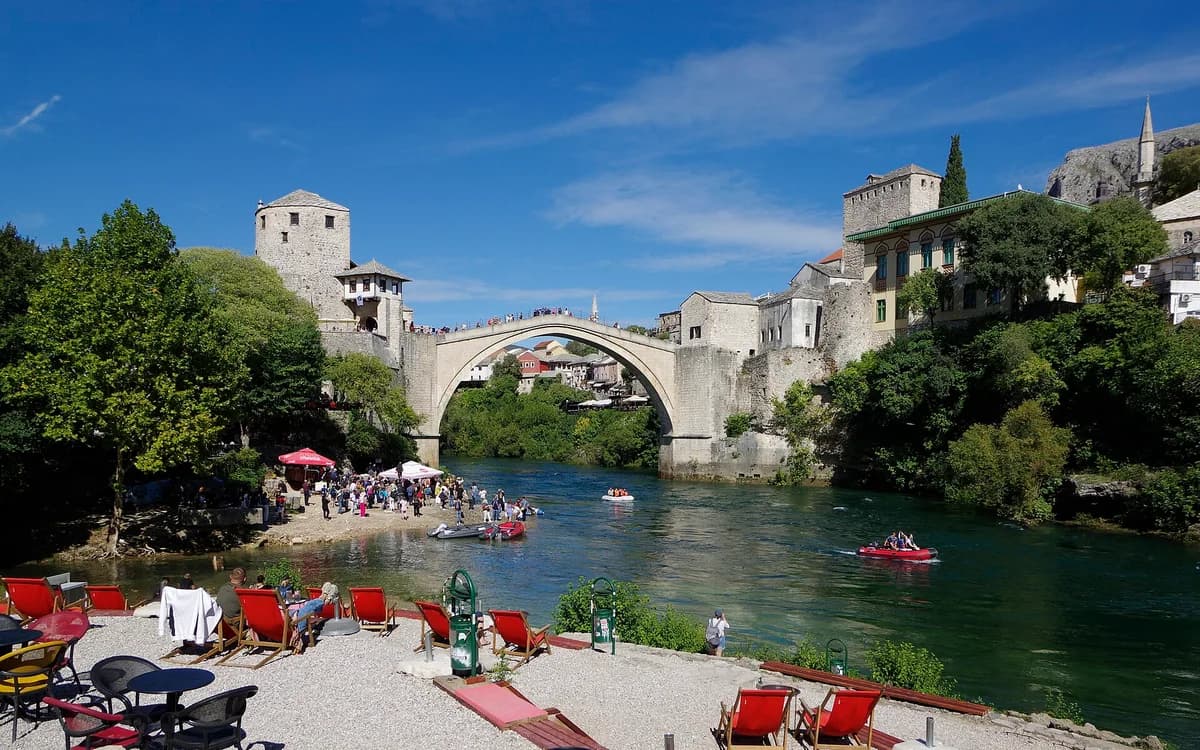
Photo credit
“Mostar Stari Most BW 2024-10-01 13-00-05” — Berthold Werner · Wikimedia Commons · CC BY-SA 4.0 · Cropped to a 16:10 editorial frame, resized to 1200×750 and converted to WebP for local web delivery.The centre of the experience is more than a single stone arch. UNESCO inscribed the Old Bridge Area of the Old City of Mostar in 2005, recognising the rebuilt bridge and the wider riverside settlement as a symbol of coexistence and international cooperation. The historic bridge was destroyed during the 1990s conflict and reconstructed, reopening in 2004. Its loss and reconstruction belong to the living story of the city; do not market it as an untouched medieval survival.
Choose Mostar when you want time on both sides of the Neretva, local architecture, public viewpoints and a longer old-town walk. Cobblestones, steps and the bridge's curved stone surface may be difficult for visitors with mobility needs. Check which museum interior, terrace or guided site you intend to enter: merely seeing the open urban landscape is different from purchasing a tour.
Mehmed Paša Sokolović Bridge, Višegrad
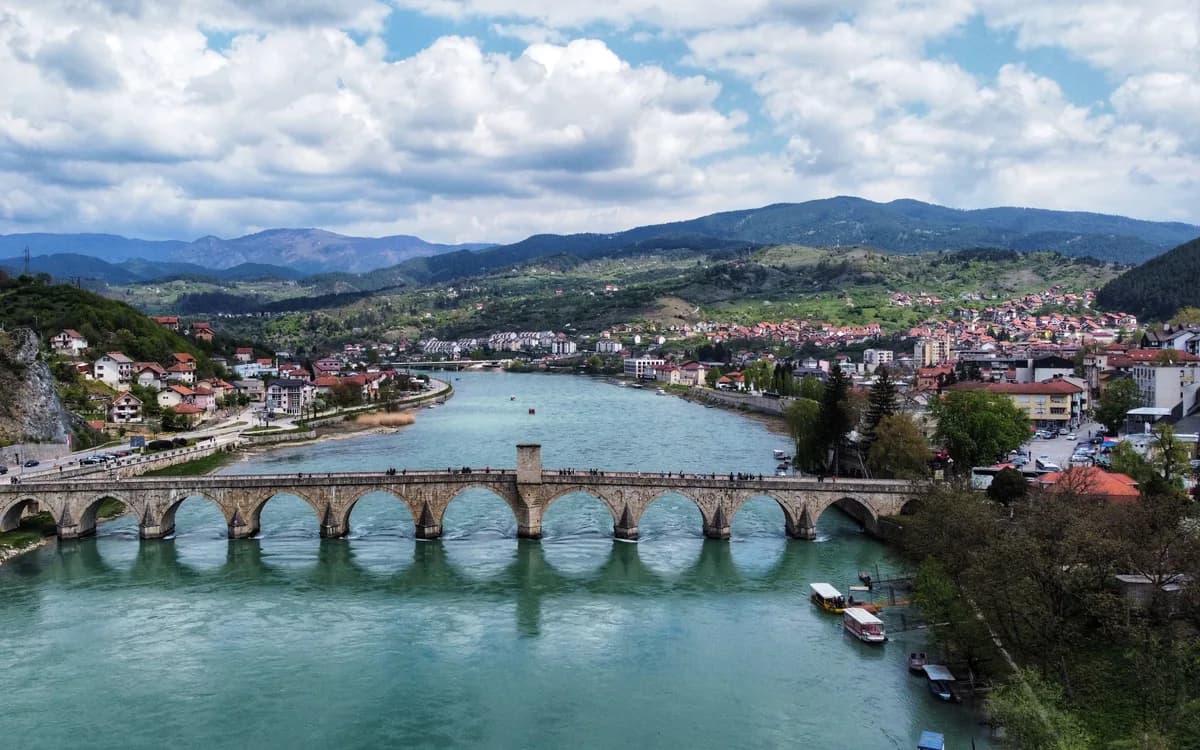
Photo credit
“Aerial view of the historic Mehmed Paša Sokolović Bridge spanning the Drina River in Višegrad” — Lazar Krstić · Pexels · Pexels License · Verified 4000×2250 original JPEG cropped to 1200×750 WebP at quality 83; normal editorial reuse under the Pexels License, with author credit and original-photo link.This eleven-arched bridge on the Drina is a distinct UNESCO World Heritage site inscribed in 2007, not part of Mostar's inscription. UNESCO identifies the late-sixteenth-century construction as an outstanding work of the Ottoman court architect Mimar Koca Sinan, commissioned by Grand Vizier Mehmed Paša Sokolović. Its long rhythm of arches and river setting make a very different visual encounter from the steep single span in Mostar.
Višegrad is in eastern Bosnia, not a walk or a short urban tram ride from a Mostar hotel. Treat it as a separately planned eastern-Bosnia stop, with confirmed overland travel and a return or overnight arrangement. This is also a town where grave crimes were committed against Bosniak civilians in 1992, documented by the UN tribunal. Approach local memory sites and people with respect rather than presenting the whole town as an uncomplicated postcard.
Stara kamena ćuprija, Konjic
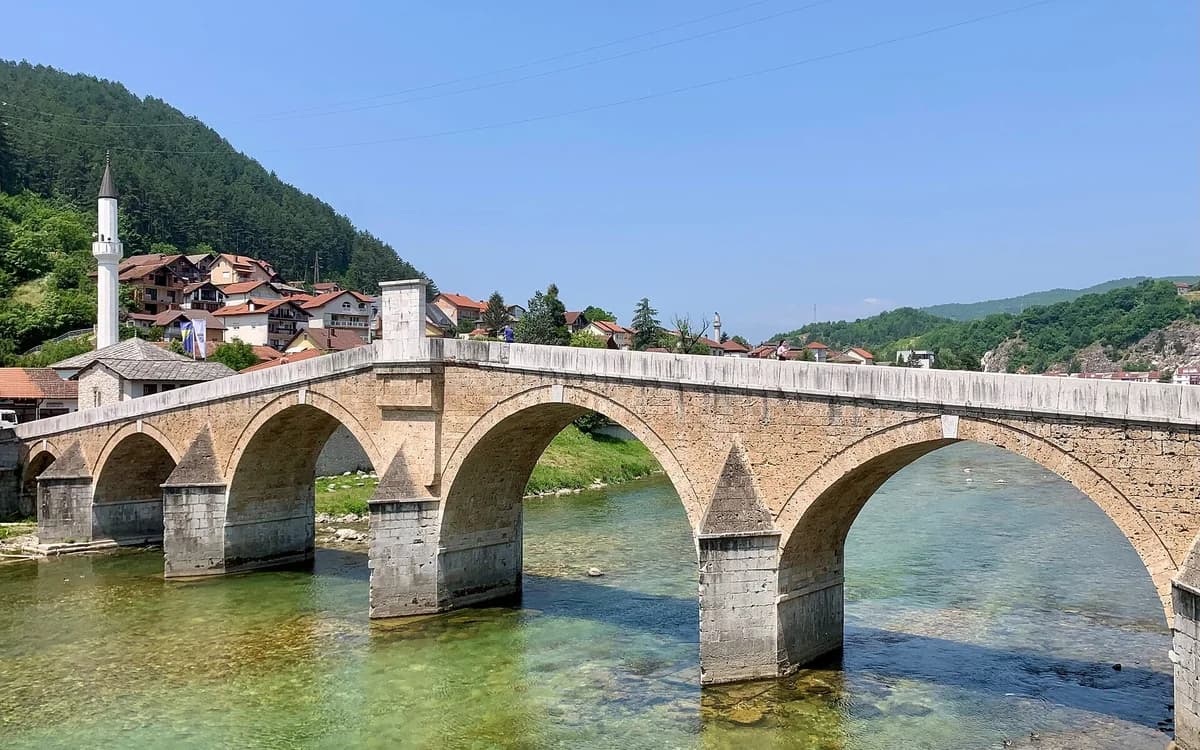
Photo credit
“Konjic Bridge” — Dudva · Wikimedia Commons · CC0 · Cropped to a 16:10 editorial frame, resized to 1200×750 and converted to WebP for local web delivery.The Konjic stone bridge, originally constructed in 1682 and opened in 1683, links the old town on the Neretva. Local authorities identify its surviving historical structure as a national monument of Bosnia and Herzegovina; that is a domestic protection category, not a UNESCO World Heritage inscription. The bridge was destroyed in 1945, replaced in stages by temporary and modern crossing structures, and reopened after stone reconstruction in June 2009.
Konjic is the sensible bridge encounter when the Neretva corridor or a Konjic town visit is already in your itinerary. Compare the bridgeside old town, cafés and riverside approaches with your available time rather than building an entire national itinerary around a photo stop. The site is an urban crossing, not an automatically booked museum or guaranteed wheelchair route; verify steps and accessible approaches before promising a barrier-free visit.
Arslanagić / Perović Bridge, Trebinje

Photo credit
“Puente Arslanagić, Trebinje, Bosnia y Herzegovina, 2014-04-14, DD 28” — Diego Delso · Wikimedia Commons · CC BY-SA 3.0 · Cropped to a 16:10 editorial frame, resized to 1200×750 and converted to WebP for local web delivery.The Ottoman-era Arslanagić/Perović Bridge is frequently associated with the patronage of Mehmed Paša Sokolović and the late sixteenth century. Its most unusual chapter is geographic: construction of the Trebišnjica hydroelectric system put the original crossing site at risk, and the stone structure was dismantled and reassembled in Trebinje. Trebinje's city heritage authority dates the relocation to 1970; tourism descriptions discuss the later rebuilding into the early 1970s. Neither story turns it into a UNESCO site.
This is a strong addition to a genuine Trebinje stay, where riverside walking and the old town are themselves the focus. Do not confuse it with the Mehmed Paša Sokolović Bridge in Višegrad simply because the patron's name appears in both histories. Check the current riverbank access and surfaces when mobility is important; a scenic bridge photo is not proof the ramp or approach suits every traveler.
Mostar: linger in the wider historic area
Mostar's Old Bridge Area is distinctive because the actual UNESCO property is an urban ensemble, not just a free-standing engineering object. Walking the east and west riverbanks introduces the fabric around the Neretva: towers, streets, houses, mosques, and a continuing community rather than an abandoned open-air exhibit. The inscription history and conservation plan matter because the bridge and much of the Old Town were rebuilt after destruction in the 1990s conflict. Describe that history openly and respectfully; reconstruction is itself part of the city's heritage.
A visitor interested in architecture should allow time for the narrow streets and river outlooks, but a riverbank panorama may be visible without every adjoining museum, courtyard or rooftop being open. If photography, accessibility, prayer times or privacy are important, establish exactly where the public routes and religious boundaries are. Commercial sightseeing offers and public bridge access should never be conflated, and crowds or slippery stones can change the quality of the experience from one day to another.
- Choose an actual base in Mostar rather than commuting just to photograph Stari Most.
- Budget time for the historic neighbourhood and read the UNESCO area's boundaries, not a generic 'UNESCO bridge' badge.
Višegrad: an eastern Bosnia chapter
The Mehmed Paša Sokolović Bridge is UNESCO's separately inscribed 2007 property on the Drina. Its court architect, Sinan, and monumental sequence of arches make the bridge legible even from a distant shore, whereas the beauty of Mostar's single high arch comes from a much smaller urban scale. UNESCO distinguishes the bridge's outstanding architectural and technical significance, its conservation history and continuing environmental vulnerability from changes to river levels. These facts do not determine whether a specific parking area, viewpoint or section of the structure is accessible today.
Plan Višegrad by your real starting city and intended next stop. An eastern-Bosnia visit is not interchangeable with Mostar's old-town afternoon or Trebinje's riverside walk. If the itinerary runs through Sarajevo, confirm a practical outbound and return service or choose a genuine overnight base before promising a car-free day. The surrounding river landscape is culturally and historically complex; the modern town deserves more than an exoticised image of stone arches.
- Check actual road and return transport to Višegrad; do not infer a timetable from a route map.
- UNESCO inscribed the bridge in 2007: do not label every attraction in town UNESCO protected.
Konjic: restoration and the Neretva
Konjic's Stara kamena ćuprija is an instructive case of restoration after very different wartime loss. Built at the end of the seventeenth century, the stone bridge was destroyed in March 1945. Provisional replacements and a later concrete crossing served the town, before a conservation-led reconstruction returned its historic stone form, reopening in 2009. The municipal national-monument description and the local visitor authority establish those milestones. They do not claim the structure is UNESCO-inscribed. That distinction is important for anyone collecting meaningful heritage stops rather than labels.
In practical terms, Konjic suits a stop chosen because the town and Neretva valley fit the travel route. You can pair a riverside look with existing Konjic sightseeing, while separate attractions such as the Tito-era bunker have entirely different visitor booking rules. No national-monument status implies automatic museum access, day-trip shuttle service or a walking surface suited to every mobility need. Plan the actual stop within a return or onward route instead of inventing convenient transfers.
- If already travelling the Neretva corridor, build Konjic into that itinerary rather than create a cross-country detour.
- Use the official Konjic national-monument description for the reconstruction timeline.
Trebinje: follow the river landscape
At Arslanagić / Perović Bridge, the memorable fact is not that its stone arches resemble other Ottoman bridges; it is that the entire historic structure was saved by relocation. Trebinje's official city cultural-heritage description explains its former upstream location and the danger from the hydropower system, while regional tourism gives a more extended dismantling and reassembly chronology. Rather than forcing an exact day in a complicated multi-year process, it was moved and reassembled during the late 1960s and early 1970s. The current riverbank is real, but not the original sixteenth-century site.
If you're staying in Trebinje, a visit can sit naturally alongside the old town and the Trebišnjica. If you're based in Mostar or Dubrovnik, ask whether you genuinely want Trebinje's wider cultural landscape before treating the bridge as a photo stop on a far longer route. The structure is also distinct from Sinan's UNESCO inscription at Višegrad, despite the shared historical name of Mehmed Paša Sokolović. Site rules and accessibility still depend on the actual path and any changes in riverbank works.
- Confirm that you are going to Trebinje's current bridge site, not searching for its submerged former position.
- Respect local residential streets and avoid intrusive photography of nearby homes or worshippers.
Where to base yourself
Choose the base that makes the next morning easier. Use the destination guide for the location trade-offs, then compare individual stays and confirm the actual journey to the attraction.
Questions that help you plan
Which bridges in this comparison are actual UNESCO World Heritage sites?
UNESCO inscribed the Old Bridge Area of the Old City of Mostar in 2005 and the Mehmed Paša Sokolović Bridge in Višegrad in 2007. Konjic's restored Old Stone Bridge is a nationally protected monument, not a UNESCO World Heritage site. Trebinje's Arslanagić / Perović Bridge is not one of the two inscriptions.
Are Mostar's and Konjic's old bridges the same bridge?
No. Both cross the Neretva but in separate towns. Mostar's Stari Most was destroyed during the 1990s conflict and rebuilt by 2004. Konjic's Stara kamena ćuprija was destroyed in 1945 and reopened after restoration in 2009. Follow the correct map and existing town guide.
Is the old bridge at Trebinje still in its original location?
No. The Arslanagić / Perović Bridge was dismantled and relocated to the present Trebinje setting because hydropower development endangered its original location. Local official history and tourism organisations place the process around the late 1960s and early 1970s.
Can I visit Višegrad from Sarajevo without a car?
Possibly, depending on the service available on your actual day, but no reliable same-day return was verified for this guide. Obtain a current transport timetable and return plan first. Do not choose a hotel or promise a day trip from the proximity of towns on a map.
Are these bridges safe and easy for wheelchair users?
The presence of a historic crossing does not establish step-free access. Mostar has sloping polished stones and a narrow old town; riverfront routes elsewhere can have uneven surfaces or works. Confirm suitable approaches locally for your needs, rather than relying on general claims about free outdoor access.
Are museums, bridges and guided tours one shared ticket?
No. UNESCO and national-monument status describe heritage significance and management, not a blanket ticket. Public viewpoints, privately managed museums, mosque interiors, guided bunker tours and any excursion transport may operate separately. Check each place's specific rules and available facilities.
Is it appropriate to include Višegrad's 1990s history in a bridge guide?
Yes, with care. The UN International Criminal Tribunal documented serious crimes against Bosniak civilians in Višegrad during 1992. That history should not be erased in a travel narrative, nor turned into sensational entertainment. Use verified historical accounts, respect survivors and local memorial practices, and avoid unverified personal stories.
Do I need four separate city stays to see these bridges?
No fixed sequence fits every trip. Mostar and Konjic suit different points along the Neretva corridor; Trebinje is a distinct Herzegovinian city; Višegrad is an eastern-Bosnia destination. Choose the cities you already want to spend time in, then add only the crossings your transport and interests support.
Sources and further reading
Operator and heritage references support the descriptions; our existing guides provide additional context. Opening, admission, transport and seasonal services can change. Check with the responsible operator for your travel date. Images carry separate credits.
- UNESCO — Old Bridge Area of the Old City of Mostar (inscribed 2005) Source reviewed 2026-10-15
- UNESCO — Mehmed Paša Sokolović Bridge in Višegrad (inscribed 2007) Source reviewed 2026-10-15
- City of Konjic — national-monument Old Stone Bridge records Source reviewed 2026-10-15
- Welcome to Konjic — bridge reconstruction and visitor setting Source reviewed 2026-10-15
- City of Trebinje — official cultural heritage and bridge relocation Source reviewed 2026-10-15
- Tourist Organisation of Republika Srpska — Trebinje bridges Source reviewed 2026-10-15
- UN tribunal case record — 1992 Višegrad atrocities and convictions Source reviewed 2026-10-15