
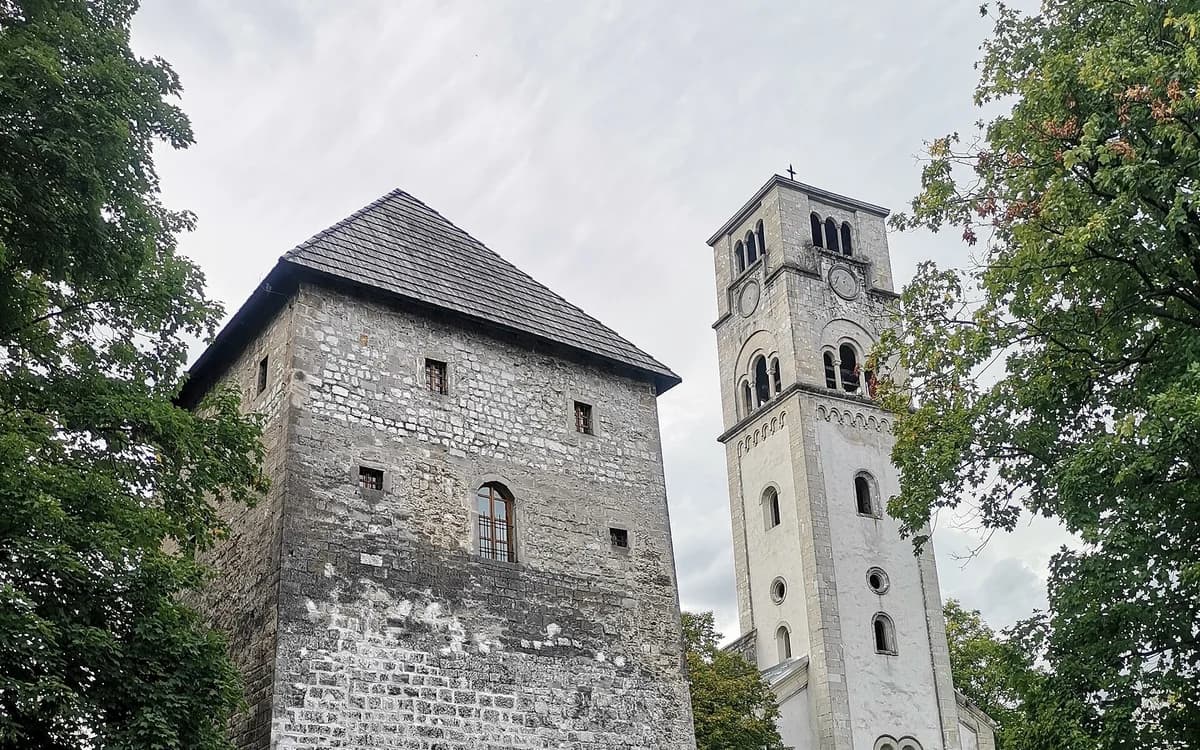
Is it worth including?
Central core · close to the riverfront It fits naturally into a visit to this part of the destination.
- Allow
- Allow 20–40 minutes for the exterior and context, or roughly an hour if a current museum visit is available.
- Getting there
- The tower is in central Bihać, within the compact historic area near Fethija and the Una.
- Ground / accessibility
- The exterior is part of the central pedestrian environment, while tower interiors by their nature may involve constrained or stepped circulation. Verify current museum accessibility before relying on interior access.
Understanding Captain’s Tower
Captain’s Tower, Kapetanova kula, is one of the most recognizable surviving structures in central Bihać, but its earliest construction history is not fully settled. City material places it among Bihać’s most important historic monuments and connects it with the fortified urban tradition of a town first documented in the thirteenth century. That uncertainty is worth preserving: the tower is evidence of Bihać’s defensive past without needing a falsely precise founding date.
Its later function is clearer. The City of Bihać identifies Captain’s Tower as a protected national monument and as part of the city’s central heritage cluster, while the building has served museum purposes connected with the Una-Sana region. Seen beside the nearby St Anthony church tower and Fethija Mosque, it helps explain how the former fortified center accumulated religious, military and civic layers within a very small area.
What to see, and what deserves a closer look
Use the tower as an orientation point rather than an isolated object. Its mass and compact footprint make more sense when you walk the few surrounding streets and compare it with Fethija, the church-tower remains and the river.
If the museum interior is currently open, let the exhibition extend the visit; if not, the exterior still anchors a useful architectural walk. Do not make the value of the stop depend on an assumed permanent interior schedule.
Look for these details
- The tower’s heavy defensive form in the middle of today’s city center.
- Its immediate relationship with Fethija Mosque and the St Anthony church-tower remains.
- The way the monument links medieval/fortified Bihać with later museum and civic use.

How to plan the visit
Captain’s Tower fits into the same one- to two-hour central Bihać block as Fethija and the Una riverfront. It should not consume the transport time reserved for Una National Park.
Check current museum information if entering the tower is important. The durable sightseeing value is the protected building and its urban context, not a promised exhibition or fixed opening pattern.
Timing & conditions
Daylight makes it easiest to read the tower together with the neighboring historic structures. Check current museum access separately if that is part of your plan.
Respectful visiting
Respect barriers and museum instructions, and avoid blocking the compact surrounding pedestrian space while photographing the tower.
Avoid these common mistakes
- Repeating a precise medieval construction story as settled fact when the tower’s earliest chronology is not securely documented in the city material.
- Driving between central monuments instead of treating them as one compact walking cluster.
Questions before you go
How old is Captain’s Tower in Bihać?
It belongs to Bihać’s historic fortified core, but the exact earliest construction date is not sufficiently certain to reduce the tower to one confidently dated building campaign.
Can Captain’s Tower be combined with Fethija Mosque?
Yes. They are part of the same compact central heritage area and are best seen on one walking circuit.
Nearby sights and a wider itinerary
Check current museum information if entering the tower is important. The durable sightseeing value is the protected building and its urban context, not a promised exhibition or fixed opening pattern.

Sources and further reading
History and visitor context are informed by these references. Geographic point provenance and licensed photo attribution are shown separately above; a Google Maps pin is not a historical source.