

Is it worth including?
Old town · walkable from Baščaršija It fits naturally into a visit to this part of the destination.
- Allow
- 30–60 minutes for the mosque and courtyard; longer if exploring the surrounding Gazi Husrev-beg vakuf ensemble
- Getting there
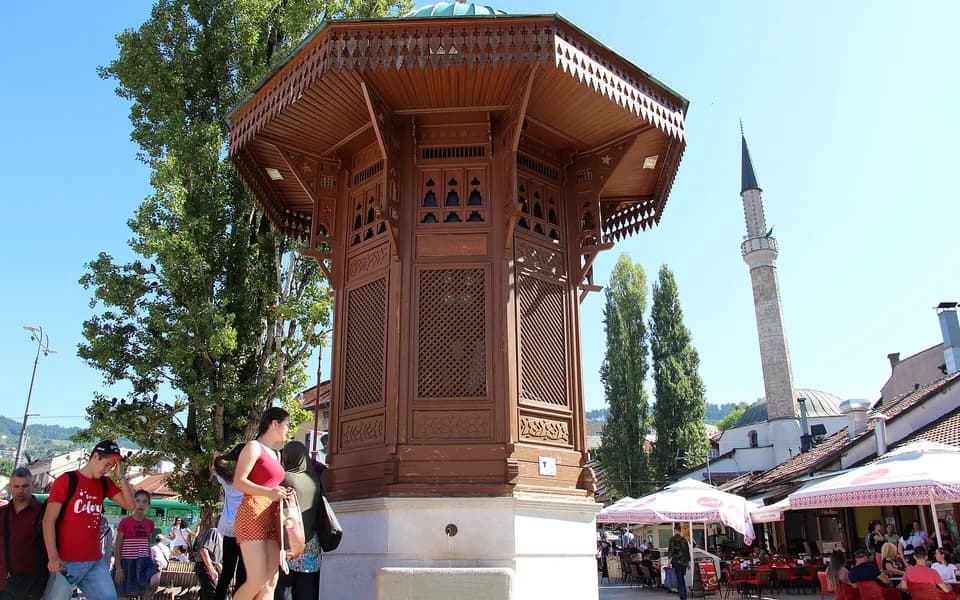
- Walk through Sarači from Sebilj or Ferhadija. The mosque is embedded directly in the pedestrian historic core, so no separate transfer is normally useful for a central sightseeing day.
- Ground / accessibility
- The courtyard is comparatively compact, but thresholds, historic surfaces and any interior visitor route may present barriers. If step-free access is essential, confirm the current arrangement with the site rather than assuming the full complex is accessible.
Understanding Gazi Husrev-beg Mosque
Gazi Husrev-beg Mosque was built in 1530–31 as the central religious monument of the endowment created by Gazi Husrev-beg, the Ottoman governor whose building programme transformed Sarajevo in the sixteenth century. His vakuf financed not only the mosque but also education, lodging, commerce, water infrastructure and charitable services, making the complex inseparable from the growth of the surrounding bazaar.
The mosque belongs to a larger ensemble rather than standing alone. A mekteb followed in the courtyard, a hanikah stood across the street, and the endowed medresa was established in 1537. Gazi Husrev-beg's tomb is in the mosque courtyard. The nearby clock tower, bezistan and other vakuf buildings still allow visitors to read this part of Sarajevo as a coordinated civic and religious centre rather than a collection of unrelated monuments.
Centuries of continued worship give the mosque a different character from a museum attraction. It remains one of Sarajevo's defining Islamic landmarks and a functioning religious site inside one of the city's busiest pedestrian areas. That continuity is the reason a respectful visit is more revealing than simply viewing the dome and minaret from Sarači.
What to see, and what deserves a closer look
Begin in the courtyard and look outward as much as inward. From here, the mosque, tombs, clock tower and surrounding commercial streets show how worship, education and trade were woven together. The scale is monumental for the old city but still intimate enough that details—stonework, the fountain court and the relationship to Sarači—are easy to notice without a long visit.
If visitor access is available, enter quietly and let the interior proportions do the work rather than treating the visit as a checklist of decoration. Afterwards, continue around the vakuf quarter instead of returning immediately to Sebilj: the clock tower, medresa and covered-market fabric explain why Gazi Husrev-beg's legacy shaped much more than a single mosque.
Look for these details
- The relationship between the mosque courtyard, Gazi Husrev-beg's tomb and the clock tower, which shows the site as an ensemble rather than an isolated building.
- The mosque's 1530–31 foundation within a vakuf that also supported education, commerce, water supply and hospitality across Sarajevo.
- The immediate transition from a functioning sacred space to Sarači and the bazaar, one of the clearest examples of mixed civic life in the old city.
How to plan the visit
Allow roughly 30–60 minutes for the mosque and courtyard, more if you want to connect it deliberately with the surrounding vakuf buildings. It fits naturally between Sebilj and the Ferhadija side of central Sarajevo, so there is little reason to make a separate transport plan for it.
Because this is an active mosque, public access can be affected by prayer, religious events and current visitor rules. Do not build a tight itinerary around an assumed entry window. If seeing the interior matters to you, check current arrangements locally or through the mosque/vakuf before setting out.
Timing & conditions
Plan flexibly around prayer and religious use. A quieter interval outside congregational prayer is better for an unhurried architectural visit; current visitor access should be checked close to the day.
Respectful visiting
Dress modestly, keep voices low, silence phones, do not walk in front of people who are praying, and follow posted guidance on shoes, photography and visitor areas.
Avoid these common mistakes
- Arriving during prayer and expecting ordinary tourist access, then treating worshippers' presence as an inconvenience rather than the primary purpose of the building.
- Leaving after a single interior photo without looking at the medresa, clock tower and market context created by the same endowment.
When a guide or organized transport helps.
Compare these options with the independent plan above. Choose the right departure base first. Sight photos illustrate the route; they are not operator photos.
Get your bearings in Sarajevo’s Old Town
Start with the streets and stories, then leave time to return for coffee and a slower walk.
- Departure base
- Sarajevo
- Time / format
- About 2 hours
Prefer your own pace? Use our city guide to build an independent walk.
Read our independent route guideQuestions before you go
Can non-Muslim visitors enter Gazi Husrev-beg Mosque?
Visitor access is commonly possible outside religious use, but the mosque is active and arrangements can change. Check current guidance and never assume entry during prayer.
How much time do I need?
About 30–60 minutes is enough for a thoughtful mosque-and-courtyard visit. Allow longer if you also want to understand the medresa, clock tower and other vakuf buildings nearby.
Nearby sights and a wider itinerary
Because this is an active mosque, public access can be affected by prayer, religious events and current visitor rules. Do not build a tight itinerary around an assumed entry window. If seeing the interior matters to you, check current arrangements locally or through the mosque/vakuf before setting out.

Sources and further reading
History and visitor context are informed by these references. Geographic point provenance and licensed photo attribution are shown separately above; a Google Maps pin is not a historical source.