
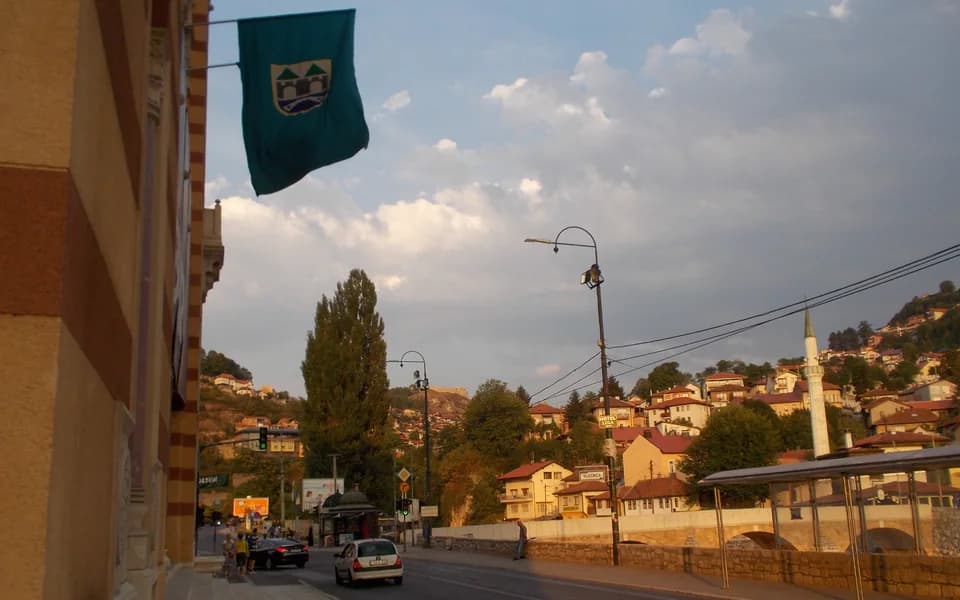
Is it worth including?
River edge · east side of the historic core It fits naturally into a visit to this part of the destination.
- Allow
- 60–90 minutes for interior and exhibitions; 15–20 minutes for an exterior-only stop
- Getting there
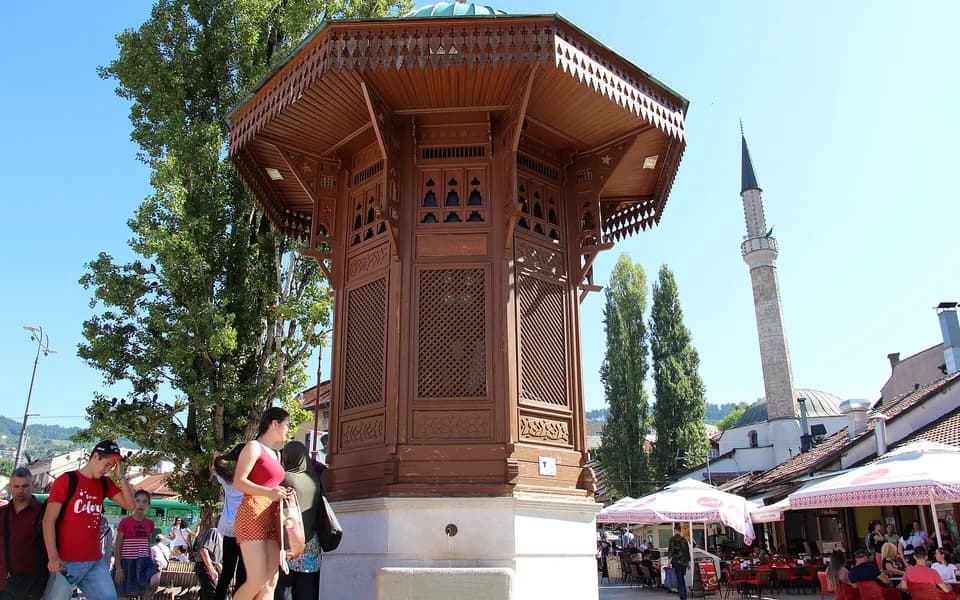
- Easy to reach on foot from Sebilj at the eastern edge of the historic core, beside the Miljacka and a major public-transport stop.
- Ground / accessibility
- The building is a multi-level historic interior. If step-free access or lift use is important, contact Vijećnica or check its current visitor information before arrival rather than assuming every exhibition room follows the same route.
Understanding Vijećnica / City Hall
Sarajevo City Hall, usually called Vijećnica, was conceived after Austro-Hungarian rule began reshaping the city in the late nineteenth century. Construction started in 1892. Karl Paržik produced an initial proposal, but the final design direction was developed by Alexander Wittek in a Neo-Moorish language and completed by Ćiril Iveković. The building was formally opened on 20 April 1896 as the seat of Sarajevo's city administration.
After the Second World War the building became home to the National and University Library. In the night of 25–26 August 1992, during the siege of Sarajevo, incendiary shelling set Vijećnica on fire. The official City Hall history records the destruction of the building together with roughly two million library items, making the site a major symbol of cultural loss as well as architectural destruction.
Reconstruction began in 1996 and continued in stages until 2014, using surviving documentation to recover the historic fabric and decoration. Vijećnica reopened on 9 May 2014. It now combines civic functions with exhibitions, cultural events and public visiting, so the restored interior is both a reconstruction of a nineteenth-century landmark and a place where Sarajevo's recent history is deliberately interpreted.
What to see, and what deserves a closer look
Do not stop at the exterior. The striped façade is the most familiar view, but the restored atrium, stairways, colored surfaces and ceremonial rooms make the architectural idea much clearer inside. The contrast between the building's decorative richness and the documented story of its 1992 destruction is the central experience of the visit.
When exhibitions are accessible, give them time rather than using the building only as a backdrop. Then step back outside toward the river and look west toward Baščaršija. Vijećnica sits exactly where the tight Ottoman bazaar opens toward the Miljacka, making it one of the best places to see two major phases of Sarajevo's urban history in a single view.
Look for these details
- The central atrium and restored decorative scheme, which reveal much more of the Neo-Moorish design than the façade alone.
- Surviving and reconstructed architectural details tied to the 1892–1896 design process of Wittek and Iveković.
- The exhibition and interpretation of the 1992 fire and long reconstruction, connecting the building's physical beauty to Sarajevo's modern history.
How to plan the visit
Allow about 60–90 minutes if you intend to see the interior and exhibitions; an exterior-only stop can fit into 15–20 minutes. The building pairs naturally with Sebilj and the eastern old-town lanes, so it works well either at the beginning or end of a Baščaršija walk.
Vijećnica is still used for civic and cultural events, and the official site explicitly notes that public access can change around events. Check the current official visitor page on the day rather than relying on a fixed timetable copied into an itinerary.
Timing & conditions
Daylight is best for reading the exterior and interior decoration together. Public access may be interrupted by official or cultural events, so check the official site close to your visit.
Respectful visiting
This is both a visitor attraction and a working civic venue. Respect closed rooms and event boundaries, avoid blocking ceremonial spaces for photographs, and treat the library-fire story as a site of cultural loss rather than a photo prop.
Avoid these common mistakes
- Photographing the façade, skipping the interior, and therefore missing the strongest architectural and historical part of the visit.
- Assuming a normal visitor schedule on a day with an official event; Vijećnica's civic use can change public access.
Questions before you go
Is it worth going inside Sarajevo City Hall?
Yes. The restored atrium, ceremonial interior and exhibitions carry much of the building's architectural and historical meaning; an exterior-only stop tells only part of the story.
Should I rely on published opening hours?
Check the official Vijećnica site close to your visit. The building hosts civic and cultural events, and public access can change when events are taking place.
Nearby sights and a wider itinerary
Vijećnica is still used for civic and cultural events, and the official site explicitly notes that public access can change around events. Check the current official visitor page on the day rather than relying on a fixed timetable copied into an itinerary.


Sources and further reading
History and visitor context are informed by these references. Geographic point provenance and licensed photo attribution are shown separately above; a Google Maps pin is not a historical source.