
Is it worth including?
Easy pairing: old town lanes + riverfront It fits naturally into a visit to this part of the destination.
- Allow
- 45–90 minutes with the surrounding Baščaršija lanes; only a few minutes for the fountain itself
- Getting there
- Best approached on foot from central Sarajevo; Sebilj sits in the pedestrian old-town square and is a natural starting point for Sarači, the craft lanes and the river edge.
- Ground / accessibility
- The square itself is open public space, but historic paving and the surrounding bazaar lanes can be uneven. Travelers using wheels should expect variable surfaces and should judge the broader old-town route, not just the fountain square.
Understanding Baščaršija & Sebilj
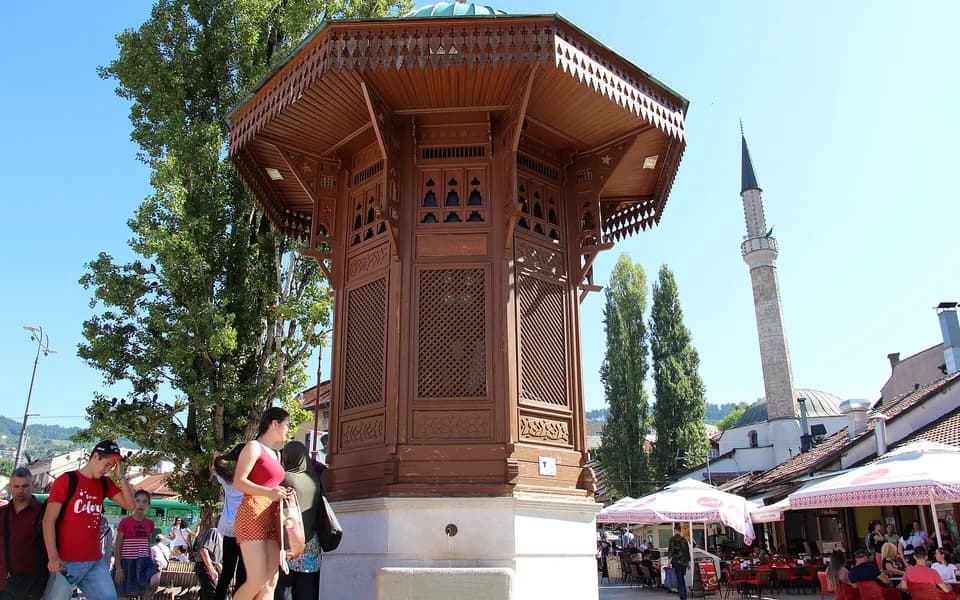
Baščaršija grew from Sarajevo's Ottoman-era commercial core, and the square around Sebilj became one of the clearest surviving orientation points inside that market landscape. The word sebilj refers to a charitable fountain where water was offered to passers-by, so the structure was originally part of a public-service tradition rather than a monument built only to be admired.
An earlier Sebilj was commissioned in 1754 by Bosnian governor Mehmed Pasha Kukavica. Fires and later redevelopment changed the square; the Baščaršija heritage site dates the present fountain kiosk to 1891 and credits architect Aleksandar Wittek (also written Vitek), who drew inspiration from an Istanbul kiosk. That sequence is a useful reminder that the square visitors see today is an Ottoman commercial space whose best-known object belongs to a later rebuilding phase.
The wider bazaar changed substantially after fires and under Austro-Hungarian administration, but Baščaršija remained the symbolic heart of the old city. Today Sebilj works less as a destination in isolation than as the natural starting point for understanding the lanes of coppersmiths, food shops, mosques, hans and river-edge monuments that radiate from the square.
What to see, and what deserves a closer look
Start by using the fountain as an orientation marker rather than trying to 'finish' the sight in a few photographs. Walk one slow circuit of the square, then follow the pedestrian flow into Sarači and the craft lanes. The contrast between the open square and the narrow bazaar streets makes the historic commercial plan much easier to read than it is from a map.
Sebilj is most rewarding when it anchors a larger old-town walk. Gazi Husrev-beg Mosque is only a short continuation through the bazaar, while Vijećnica and the Miljacka sit toward the eastern edge of the same compact sightseeing zone. Returning through the square later in the day also changes the atmosphere: commuter movement, café tables and evening promenading make Baščaršija feel like a lived city centre rather than an outdoor museum.
Look for these details
- The 1891 Sebilj itself, a later rebuilding of a much older Sarajevo tradition of charitable public fountains.
- The shift from the open Baščaršija square into Sarači and the specialized craft streets, which makes the bazaar's urban structure legible on foot.
- The easy visual axis between the market, Vijećnica and the Miljacka, useful for understanding how the Ottoman core meets later Austro-Hungarian Sarajevo.

How to plan the visit
Allow about 45–90 minutes for Sebilj and the immediate bazaar if this is your first orientation walk; the fountain itself needs only a few minutes. A better plan is to make it the beginning or end of a half-day central Sarajevo circuit linking Gazi Husrev-beg Mosque, Latin Bridge and Vijećnica instead of scheduling separate transfers between them.
The square is easiest to appreciate on foot. If you arrive with luggage or by car, solve that separately before entering the pedestrian bazaar: the useful accommodation question is how easily you can reach the valley-floor old town, not how many metres a hotel pin sits from the fountain.
Timing & conditions
Early morning gives the clearest look at the square and shopfronts; late afternoon and evening are livelier. There is no need to chase a fixed opening hour for the outdoor fountain, but nearby museums and religious buildings have their own schedules.
Respectful visiting
Treat the square as shared civic space: keep shop entrances clear, ask before photographing people at close range, and remember that nearby mosques are active places of worship rather than scenery.
Avoid these common mistakes
- Treating Sebilj as a stand-alone photo stop and leaving before walking the bazaar streets that give the fountain its context.
- Assuming every nearby attraction shares the same visitor schedule; the square is open public space, but mosques, museums and interiors around it have separate arrangements.
When a guide or organized transport helps.
Compare these options with the independent plan above. Choose the right departure base first. Sight photos illustrate the route; they are not operator photos.
Get your bearings in Sarajevo’s Old Town
Start with the streets and stories, then leave time to return for coffee and a slower walk.
- Departure base
- Sarajevo
- Time / format
- About 2 hours
Prefer your own pace? Use our city guide to build an independent walk.
Read our independent route guideQuestions before you go
Is Sebilj worth a separate stop?
Yes as an orientation point, but its value comes from the surrounding Baščaršija. Build it into an old-town walk rather than travelling across Sarajevo only to photograph the fountain.
What should I pair with Sebilj?
Gazi Husrev-beg Mosque is the most natural continuation through the bazaar; Vijećnica and the Miljacka make an equally easy extension in the opposite direction.
Nearby sights and a wider itinerary
The square is easiest to appreciate on foot. If you arrive with luggage or by car, solve that separately before entering the pedestrian bazaar: the useful accommodation question is how easily you can reach the valley-floor old town, not how many metres a hotel pin sits from the fountain.

Sources and further reading
History and visitor context are informed by these references. Geographic point provenance and licensed photo attribution are shown separately above; a Google Maps pin is not a historical source.