
The practical answer
Žilavka is a white grape closely associated with Herzegovina; Blatina is a regional red with functionally female flowers that need pollinating varieties. Neither name guarantees one flavour, blend or food pairing. Ask about the producer, vintage and grape composition of the actual bottle. Trnjak and Vranac are separate varieties, not alternate names for Blatina.
Compare the options
| Decision | Žilavka: begin with a native white variety | Blatina: a local red with an unusual growing constraint |
|---|---|---|
| Basic identification | White grape and regional white-wine tradition | Red grape and regional red-wine tradition |
| Distinctive topic | Grower and producer styles across Herzegovina's karst landscape | Functionally female flowers and the need for nearby pollen-producing varieties |
| Other variety to understand | Vranac is a separate red grape, not a Žilavka synonym | Trnjak may grow as a pollinator but is itself a separate grape |
| What an official overview cannot tell you | Which producer's bottle, vintage, grape proportions or price will be served | Today's exact wine composition, winery visitor access or tasting offer |
| Question to ask a producer | Is this a single-variety Žilavka and what food, if any, is offered? | Is this labeled Blatina a blend and which varieties contributed? |
| Responsible plan | Choose one confirmed visit with a non-drinking driver or a verified transfer | The same rule: no alcohol before driving, however small the pour |
Žilavka: begin with a local white variety
The Herzegovina Wine Route introduces Žilavka among its main regional wines, and the older tourism-board wine profile treats the grape as deeply connected to Herzegovina's karst landscape. The term names a variety, not a fixed bottle or a universally agreed tasting note. Producers can make wines of different styles and vintages from the same grape; food recommendations from a regional tourism guide are suggestions, not assurances that a restaurant or cellar sells an exact Žilavka today. If your group is learning about wine, ask for the producer's actual grape composition, origin and alcohol-free participation arrangements rather than reciting a universal flavour list.
Blatina: a red grape with a growing quirk
The regional wine-route authority describes Blatina's functionally female flowers: growers plant pollinating varieties alongside it, including Trnjak and other reds. This helps explain why vineyard planting and a particular wine's grape composition need separate interpretation. The source also discusses blends and typical historic winemaking practice, but it does not establish today's composition of every producer's label. Ask which grapes are in the named wine, where the fruit was grown, and whether the proposed tasting actually includes that wine. A photograph of local stone architecture cannot authenticate a bottle or a vineyard.
From the grape name to the bottle
An independent wine traveler will encounter grape names on wine-route material, restaurant lists, producer menus and souvenir shelves. Those formats give different levels of certainty. The HWR homepage introduces Žilavka, Blatina, Vranac and Trnjak as noteworthy varieties, but does not certify that every cellared bottle is made from just one variety, that every vintage tastes the same, or that a producer's tasting is open that afternoon. A published regional flavour description is the route's characterization, not a tasting conducted by BosniaUnfolded. Wine descriptions depend on growing site, harvest year, cellar work, storage and individual producer. If you want to compare drinks, ask for the complete exact label and composition first; if a producer cannot offer an appropriate sample, choose a meal or town walk instead.
The older Herzegovina tourist wine route's Blatina background is useful for explaining how viticulture shapes this red variety. Because Blatina has functionally female flowers, the variety requires another suitable plant for pollination. Some sources describe Trnjak, Merlot and Alicante Bouschet in that context; the presence of pollinators in a vineyard does not prove the proportional blend in a specific bottle. The same source presents traditional wine composition practices that may not generalise to every current wine. Distinguish this botanical fact from any promoter's bottle-specific tasting claims. This is agricultural history and producer research, not an instruction to drink more.
- Read the producer's own current label and wine list after the regional grape overview.
- Ask whether the drink is varietal or blended; never infer the grape percentages from a regional description.
Where Trnjak and Vranac fit
The main Herzegovina Wine Route prominently mentions Trnjak and Vranac alongside Žilavka and Blatina. Those are not marketing labels for a single red wine. Trnjak belongs in the regional grape story partly because of its links with vineyards containing Blatina; it may also appear under its own name in a producer's range. Vranac is widely associated with other Balkan wine-growing regions as well, and the HWR includes it in descriptions of eastern-Herzegovina producers. Treat such listings as documentary background for what a traveler might ask about, never as verification that a given wine is stocked or that an open tasting can be booked without notice.
The regional experience changes with geography. A Mostar-based visitor might study the grape story while arranging a genuine Čitluk visit, but those cellars are outside the Old Bridge lanes. A Trebinje visitor could read about the locally listed Tvrdoš and Vukoje experiences, yet a wine museum, monastic shop, church, cellar tour and restaurant are not automatically the same door. Don't use a bottle's grape name as a shortcut to current access, transport, photography permission or a tasting at the monastery. With alcohol, decide in advance who will remain sober or book verified professional transport. Without alcohol, old-town culture and meals are equally legitimate reasons to visit Herzegovina.
- Use the official HWR member directory to identify a real provider, not an invented generic vineyard.
- Confirm which grape and actual vintage a selected venue proposes to show.
Mostar and a separate Čitluk excursion
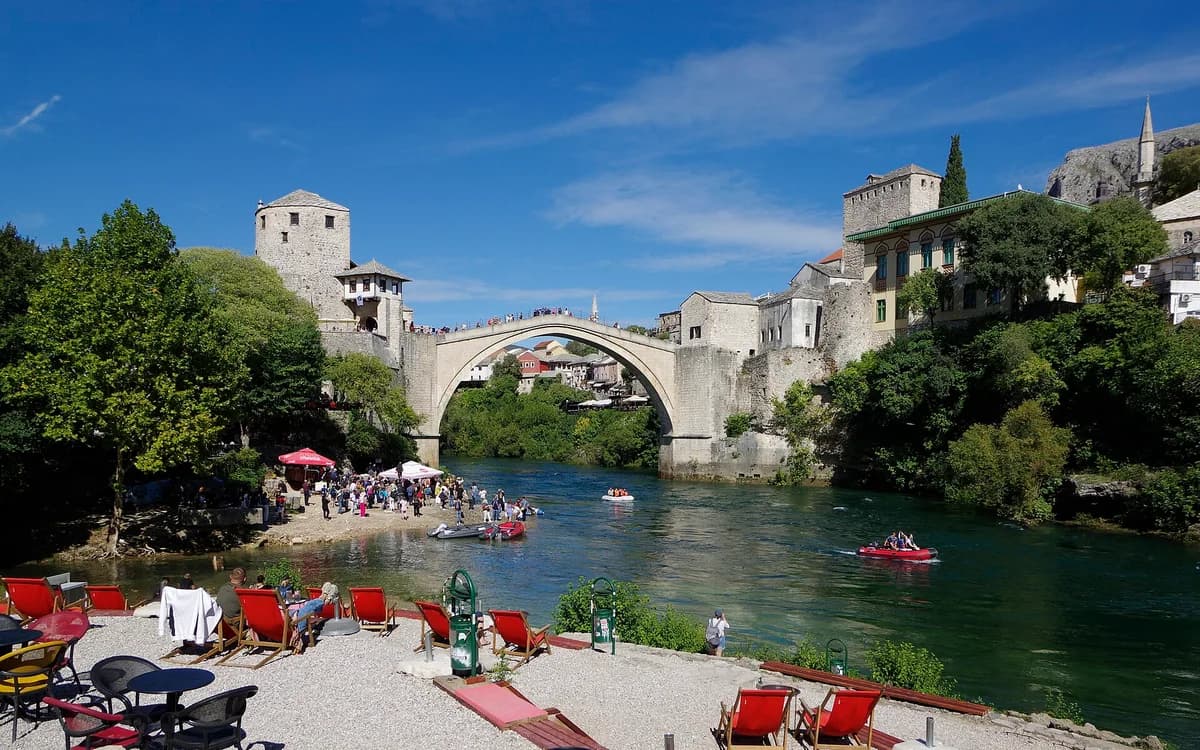
Photo credit
“Mostar Stari Most BW 2024-10-01 13-00-05” — Berthold Werner · Wikimedia Commons · CC BY-SA 4.0 · Cropped to a 16:10 editorial frame, resized to 1200×750 and converted to WebP for local web delivery.Mostar works as a city base to learn the region's wine vocabulary and arrange a separately confirmed Čitluk-area cellar visit. Trebinje belongs to a different regional plan; no verified same-day multi-cellar circuit or transfer is implied.
Where to base yourself
Choose the base that makes the next morning easier. Use the destination guide for the location trade-offs, then compare individual stays and confirm the actual journey to the attraction.
Questions that help you plan
Is Žilavka red or white?
Žilavka is a white grape and is associated with Herzegovina white wines. The actual wine style and blend depend on the named producer and bottle.
What makes Blatina distinctive?
The tourism-board grape profile describes functionally female flowers, so it needs compatible pollinators grown nearby. That vineyard fact does not specify the composition of every bottle.
Are Blatina and Trnjak the same grape?
No. Trnjak is another red grape and can be relevant as a pollinator in Blatina vineyards, but the two names are not synonyms.
Is Vranac a local name for Blatina?
No. Vranac is a separate red grape grown in the wider Balkans and present in some Herzegovina winery descriptions.
Can I reserve a Žilavka-versus-Blatina tasting here?
No live tasting, time, price or provider offer has been verified here. Read actual HWR listings and confirm directly with the venue before travel; arrange a sober return.
Do I have to drink to learn about the wine region?
No. The wine-growing landscape, food culture and town heritage can all be appreciated alcohol-free. Check child access and non-alcoholic alternatives with individual providers.
Sources and further reading
Operator and heritage references support the descriptions; our existing guides provide additional context. Opening, admission, transport and seasonal services can change. Check with the responsible operator for your travel date. Images carry separate credits.
- Herzegovina Wine Route — four featured regional varieties and wine towns Source reviewed 2026-10-15
- Herzegovina tourism-board wine route — specific Žilavka overview Source reviewed 2026-10-15
- Herzegovina tourism-board wine route — Blatina and pollination Source reviewed 2026-10-15
- Herzegovina Wine Route — named winery experiences and booking filter Source reviewed 2026-10-15
- Herzegovina Wine Route — Čitluk and Brotnjo regional geography Source reviewed 2026-10-15
- Herzegovina Wine Route — Trebinje region and food/wine context Source reviewed 2026-10-15