
Is it worth including?
Central Mostar · useful between Old Town and station side It fits naturally into a visit to this part of the destination.
- Allow
- 20–40 minutes for the square, memorial and Gymnasium exterior
- Getting there
- Easy to reach on foot from central Mostar and useful on the walking line between the station side of the city and the Old Town.
- Ground / accessibility
- The square is an urban public space with generally level approaches, but road crossings and changing pavement conditions matter more than attraction stairs. Use marked crossings and allow extra time if traffic is busy.
Understanding Spanish Square
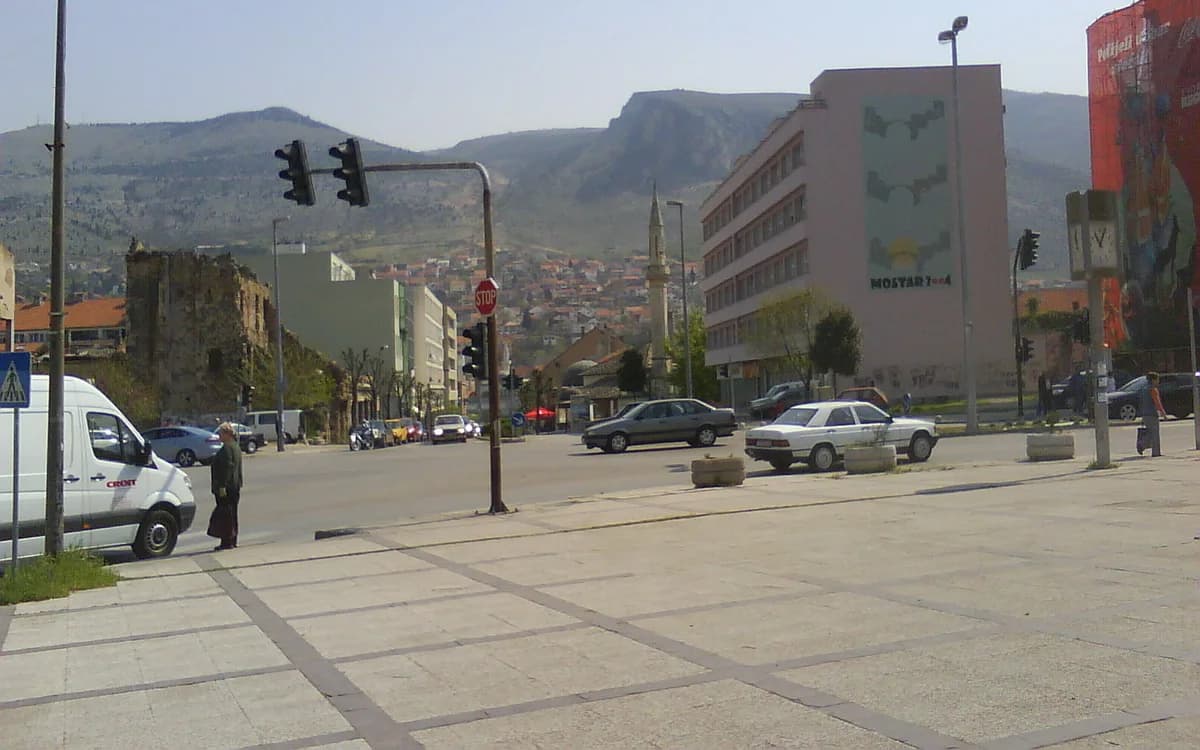
Spanish Square, Španski trg, sits in Mostar's modern centre beside the landmark Gymnasium rather than inside the Ottoman Old Town. The Gymnasium was founded in 1893, and the current Moorish Revival building developed in stages from 1898 to 1902 under architect František Blažek. Its Alhambra-inspired decoration makes the square an important stop for understanding the Austro-Hungarian layer of Mostar's architecture.
The square's modern name and memorial meaning come from the international peacekeeping presence during the 1990s war. In March 2012, King Juan Carlos I of Spain and Bosnian officials formally opened the renewed Spanish Square and honored Spanish soldiers who died while serving in Bosnia and Herzegovina. Bosnia and Herzegovina's Council of Ministers records the monument to 21 members of the Spanish UN peacekeeping contingent at the square.
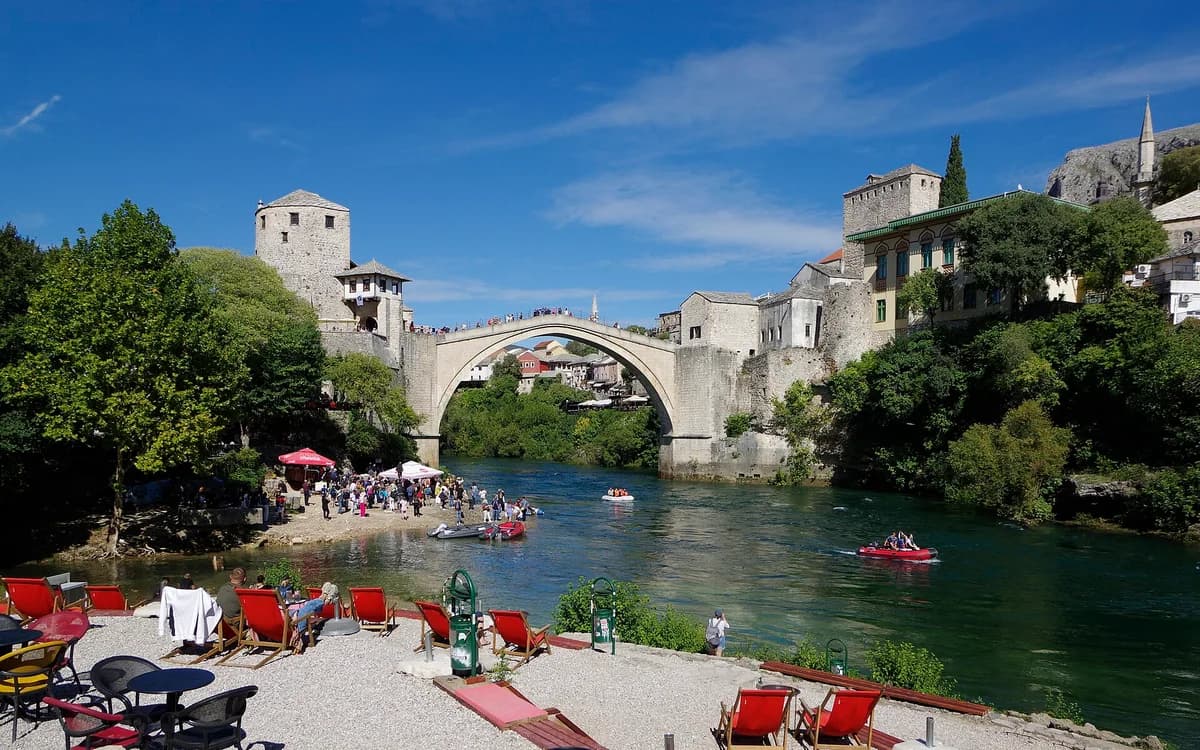
Today the square is useful precisely because it shifts the visitor away from the postcard version of Mostar. It is part memorial, part traffic and pedestrian junction, and part civic space beside schools, parks and the boulevard. Walking here from Stari Most shows how the city extends beyond the historic tourist core and makes the contrast between Ottoman, Austro-Hungarian and postwar layers visible within a short central walk.
What to see, and what deserves a closer look
Make the Gymnasium façade the visual anchor, then look for the Spanish memorial rather than treating the square as an empty plaza. The school building rewards a slow exterior look: its color, ornamental pattern and scale are dramatically different from the stone Old Town and explain why Mostar's architectural identity cannot be reduced to Stari Most.
Use the square as a hinge in a wider central walk. From here you can continue toward parks and the modern centre or walk south-east toward the Old Town. The route is valuable for urban context, not because the square itself needs a long attraction visit.
Look for these details
- The Moorish Revival façade of Mostar Gymnasium, developed around the turn of the twentieth century and inspired by Alhambra motifs.
- The memorial connected with Spanish peacekeepers who died during service in Bosnia and Herzegovina.
- The urban transition from the modern boulevard and civic centre toward the historic Old Town, useful for seeing Mostar as more than one heritage quarter.
How to plan the visit
Allow about 20–40 minutes for the square, memorial and exterior of the Gymnasium. It makes most sense as part of a walk between the station/modern centre and Stari Most, or as a deliberate contrast after spending time in the Old Town.
This is an active urban junction with roads, schools and everyday pedestrian traffic. Do not expect a controlled attraction entrance or a fixed visiting programme. If you want interior access to a nearby institution, research that institution separately; the square visit itself is primarily outdoor and contextual.
Timing & conditions
Daylight is best for the Gymnasium façade and memorial context. The square does not need a timed ticket; pair it with other central stops when the walking conditions are comfortable.
Respectful visiting
Treat the memorial to fallen peacekeepers respectfully and remember that the Gymnasium remains an educational building, not a visitor set. Avoid photographing students at close range without permission.
Avoid these common mistakes
- Skipping the square because it lacks an Old Town aesthetic; that contrast is exactly what makes it useful for understanding Mostar's later urban history.
- Treating the Gymnasium as a museum attraction and assuming unrestricted interior access; it is a functioning educational institution.
Questions before you go
Why is it called Spanish Square?
The square commemorates the Spanish peacekeeping presence in Bosnia and Herzegovina and includes a memorial to Spanish soldiers who died while serving in the country.
Is Spanish Square part of Mostar's Old Town?
No. It sits in the modern central city by Mostar Gymnasium. That makes it a useful contrast to the Ottoman Old Town and a good stop on a walk between the station side and Stari Most.
Nearby sights and a wider itinerary
This is an active urban junction with roads, schools and everyday pedestrian traffic. Do not expect a controlled attraction entrance or a fixed visiting programme. If you want interior access to a nearby institution, research that institution separately; the square visit itself is primarily outdoor and contextual.
Sources and further reading
History and visitor context are informed by these references. Geographic point provenance and licensed photo attribution are shown separately above; a Google Maps pin is not a historical source.