
The practical answer
Give Mostar at least one unhurried day if it is your first visit. Build the core around Stari Most and the Old City, cross the Neretva more than once, then walk into the modern centre so the UNESCO zone is not mistaken for the entire city. Use a second day for Blagaj, Počitelj and Kravica rather than compressing all of Herzegovina into the same afternoon.
- See Stari Most early and again later; the bridge changes with light and crowd levels.
- Walk both banks and include the modern centre so Mostar is not reduced to one postcard.
- Choose one elevated viewpoint or minaret rather than repeating the same panorama from multiple paid stops.
- Separate Mostar city time from a Herzegovina excursion unless you truly have only one day.
- An overnight is valuable because it gives you the Old City before and after peak excursion hours.
Plan for an evening as well as the headline sight
Editorial day structure, with room for a slower meal or coffee stop. Specific venues and their current visitor rules appear in the detailed guide.
| Part of visit | Plan | Stay implication |
|---|---|---|
| Arrival | Check in or confirm luggage storage before the historic-core walk | Choose the entrance with luggage access in mind |
| City time | Group the Old Bridge and Old Town rather than adding a distant outing immediately | Stay near the core if that is the main purpose |
| Evening / morning | Leave time to return to the streets at a different part of the day | An overnight adds something a rushed transfer does not |
| Wider Herzegovina | Put a regional excursion on a separate day with its own transport plan | Confirm the return before booking another overnight |
If the plan changes: In heat or rain, reduce the outdoor walking and leave longer breaks. Check museum and venue hours directly; do not assume every attraction keeps the same opening pattern.
Mostar works best as a city walk plus a separate Herzegovina decision
The Old Bridge area is compact, but Mostar becomes more interesting when you distinguish the UNESCO core from the wider city and the day trips outside it.
| Core visit | 1 unhurried dayEnough for the Old City, both riverbanks, a viewpoint and the modern centre without racing. |
|---|---|
| Best first walk | Old City on both banksCross Stari Most, circle back by another river crossing and look at the bridge from more than one level. |
| Wider context | Modern MostarThe city continues well beyond the UNESCO-listed core. |
| Second-day choice | Blagaj + Počitelj + KravicaTreat the Herzegovina loop as its own excursion instead of stealing hours from Mostar. |
| Main mistake | Arrive at midday, photograph the bridge, leaveThat sees the landmark but misses the city rhythm and the value of an evening or early morning. |
Use the sightseeing plan to choose the right base.
Choose around the visit you want: time in the Old Town, an overnight before a wider outing, or a room that suits your arrival and luggage.
Keep an evening for the Old Town
Compare Old Town and central-city addresses before booking an overnight. Confirm the approach to the entrance; proximity to the bridge does not guarantee an easy luggage route.
Compare Mostar stay areasArrive by train or coach
Start with the actual terminal on your ticket, then compare it with the accommodation entrance. Check luggage storage, check-in arrangements and the return route for any day trip.
Choose a Mostar stay without a carFind a room for a longer visit
Compare the current hotels, apartments and hostels. Confirm private versus shared facilities and your room's capacity before using Mostar as a base for wider Herzegovina.
Browse Mostar accommodationPlan the experience, not just the pin.
Use these sections for the route, timing and on-the-ground choices that shape the day.
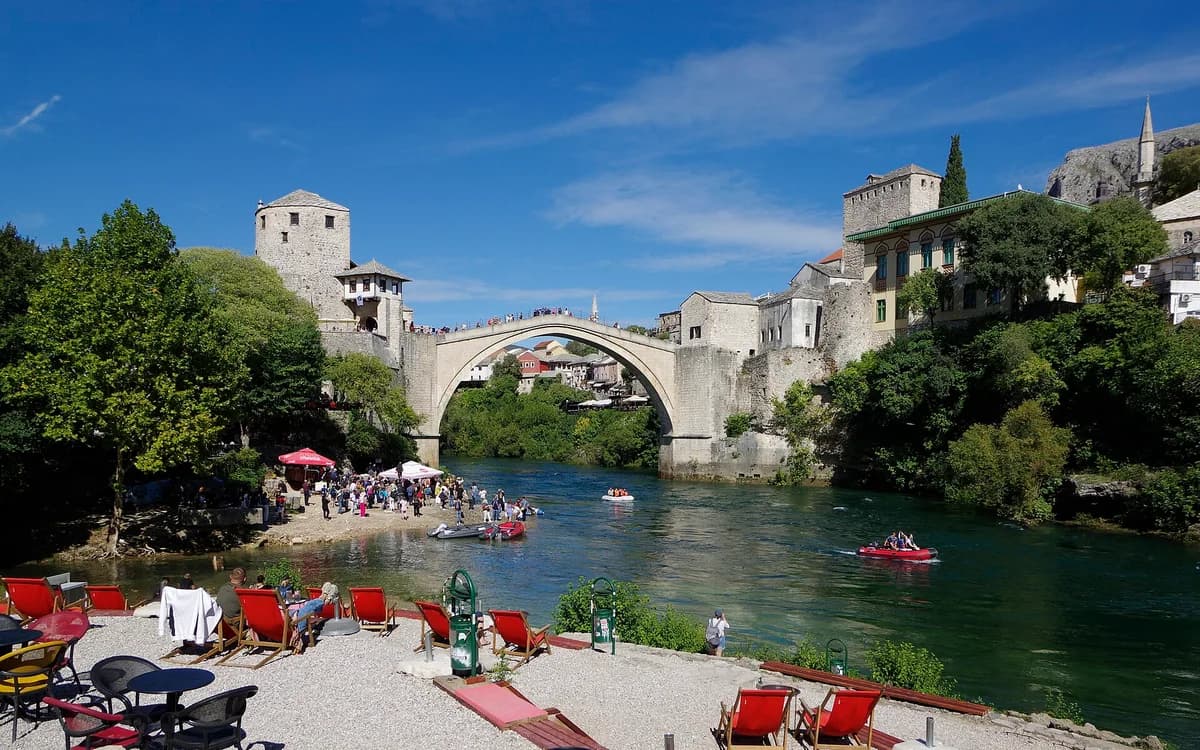
Start with Stari Most, then make the whole Old City the attraction
The bridge is the reason many visitors come, but the UNESCO designation is for the Old Bridge area and the urban fabric around it—not an isolated arch.
Stari Most deserves time because it is both a remarkable piece of bridge engineering and the centre of a larger historic landscape. UNESCO describes the Old Bridge area as the product of pre-Ottoman, Ottoman, Mediterranean and western European influences, with the rebuilt bridge and Old City carrying strong symbolic meaning after the destruction of the 1990s. Begin at river level and let the lanes on both banks explain how the bridge connects neighbourhoods rather than treating it as a viewing platform detached from the town.
Walk the cobbled market streets, move between the bridge towers and river viewpoints, and cross the Neretva more than once. The useful detail is not the exact number of souvenir shops or cafés; it is how steep lanes, stone roofs, religious buildings and the river form one dense pedestrian environment. Early morning provides the clearest sense of the place before excursion groups arrive, while late afternoon and evening restore some of that spatial rhythm after the busiest middle of the day.
Official links
Choose one good viewpoint instead of buying the same panorama repeatedly
Mostar's geography makes elevated viewpoints tempting: steep riverbanks, minarets and surrounding hills all promise another angle over the bridge and roofs. A first-time visitor usually needs one deliberate elevated view, not every option. Pick the viewpoint that fits your comfort with stairs, access rules and current opening conditions, then spend the rest of the time at street and river level where the historic core is easier to read.
The City of Mostar tourism material highlights the Old Bridge alongside mosques, churches and the wider urban heritage. That is a useful reminder that the skyline is part of a mixed city, not a stage set built around one landmark. If a viewpoint is closed, crowded or uncomfortable, do not treat the visit as incomplete; the bridge approaches, riverbank views and streets above the Neretva provide multiple strong perspectives without turning the day into a viewpoint collection.
Walk beyond the Old City so the UNESCO core does not become 'all of Mostar'
A common short-visit mistake is to turn around at the edge of the souvenir streets and assume the city ends there. Walk toward the modern centre and the broad streets around Spanish Square and the Austro-Hungarian urban fabric. The contrast is one of Mostar's useful lessons: an Ottoman-era river crossing and market core sit inside a larger city shaped by later political, architectural and social layers.
This wider walk also changes practical decisions. Restaurants, cafés, shopping, transport nodes and accommodation are distributed beyond the tight Old City. If your hotel is closer to the station or modern centre, that is not automatically a sightseeing disadvantage; it may simply mean a longer but still useful walk into the historic zone. The separate Mostar stay guide owns the accommodation decision, while this sightseeing page explains why both sides of that walk matter.
Official links
Do not turn Blagaj, Počitelj and Kravica into three hurried add-ons
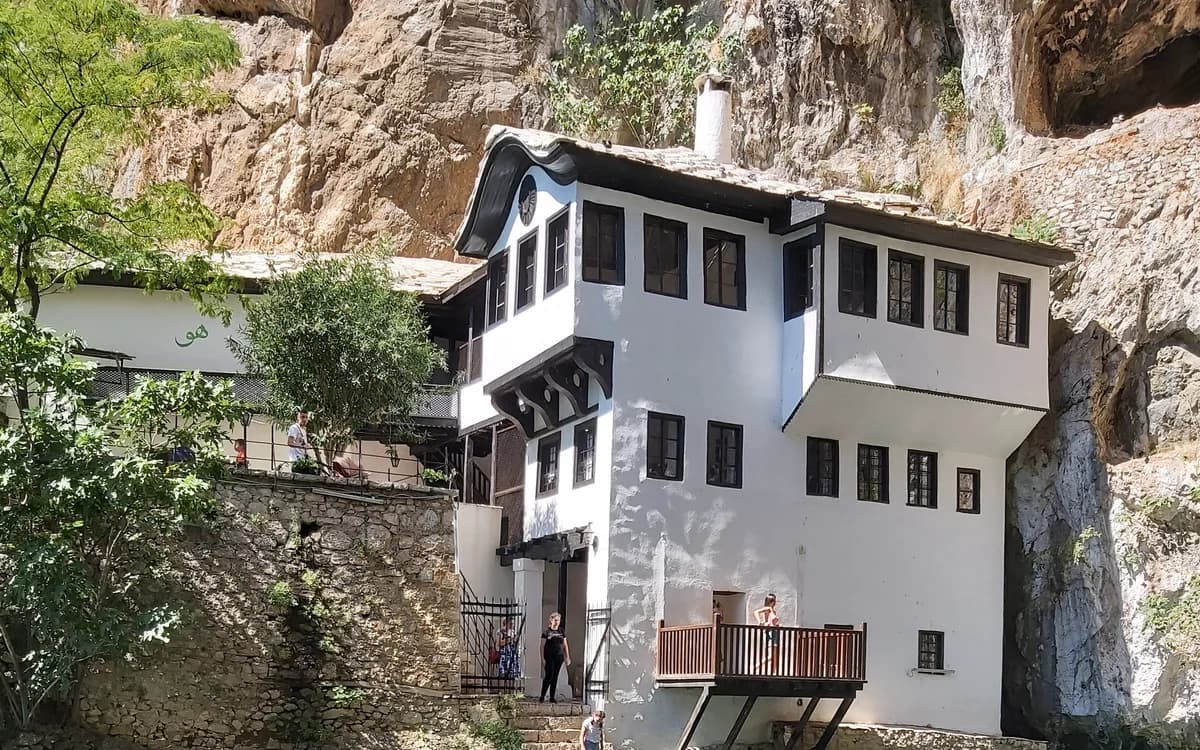
Blagaj, Počitelj and Kravica are not suburbs you can casually sweep up after a full Mostar walking day. Blagaj combines the Buna spring landscape with the Tekke; Počitelj is a historic stone settlement on the Neretva corridor; Kravica is a waterfall landscape on the Trebižat. They ask for different kinds of attention and road movement. The City of Mostar tourism material itself treats Blagaj and the wider natural attractions as a separate regional offer.
If you have a second day, combine the three as a deliberate Herzegovina loop with a clear order and enough slack for seasonal conditions. If you have only one day total in Mostar, choose the city first unless one of those sites is the actual reason for the trip. The dedicated day-trip guide compares the regional options, while the Blagaj–Počitelj–Kravica article gives a route logic for travellers who specifically want that trio.
Plan around heat and crowd rhythm instead of chasing a perfect checklist
Mostar's exposed stone and summer climate can make the middle of the day feel much harder than the map suggests. A practical warm-weather day starts early in the Old City, moves to a slower meal, museum, shaded street or rest period at the hottest point, then returns to the river area later. This is not about avoiding the city in summer; it is about matching the walking rhythm to conditions rather than insisting on constant movement from morning to evening.
Crowds follow a similar logic. Excursion groups concentrate around the Old Bridge at predictable parts of the day, while an overnight visitor has access to quieter early and later periods. That is the strongest non-commercial reason to sleep in Mostar. One hotel change buys you an evening, an early start and a much better platform for a second-day Herzegovina excursion.
| If you have | Mostar focus | Regional add-on |
|---|---|---|
| Half day | Old Bridge area + both banks | None |
| 1 full day | Old City + wider centre + one viewpoint | Only if a specific site matters more than city depth |
| 2 days | One city day | One Blagaj/Počitelj/Kravica day |
| 3+ days | Slower city time | Add Trebinje, Stolac or another distinct Herzegovina chapter |
A city walk and a Herzegovina tour solve different questions
Keep a first Mostar day focused on the Old City, both banks and the wider centre. A local walking guide may help interpret that route. A tour to Blagaj, Počitelj and Kravica is a separate regional day and should not be treated as the way to see the city itself.
When you compare organized options, start with the meeting point and departure base. Check whether the time advertised is for the city walk or the whole excursion and which entrances are extra. Leave a free block for exploring after the guided portion rather than try to schedule every minute around it.
When a guide or organized transport helps.
Compare these options with the independent plan above. Choose the right departure base first. Sight photos illustrate the route; they are not operator photos.

Make a day of Blagaj, Počitelj and Kravica
An organized departure from Mostar can simplify the transfers between three very different stops.
- Departure base
- Mostar
- Time / format
- About 5–8 hours
Compare the stop order and transport choices in our independent route guide.
Read our independent route guideLook beyond the Old Bridge in Mostar
Choose a city walk for historical context; save the regional waterfalls and villages for another day.
- Departure base
- Mostar
- Time / format
- City walking experience
Our Mostar guide also works as an independent city plan.
Read our independent route guideBefore you set a Mostar sightseeing day
- Protect enough time to walk both banks of the Old City instead of photographing Stari Most from one approach.
- Choose one elevated viewpoint and verify current access rather than planning several similar climbs.
- Include some of the wider centre so Mostar is not reduced to its UNESCO core.
- Move Blagaj, Počitelj and Kravica to a second day when possible.
- In hot weather, use early morning and later afternoon for the most exposed stone-and-river walking.
Short answers before you set the day.
How long do you need in Mostar?
One full day is a strong minimum for the Old City and wider centre without rushing. Two days are better when you also want a Herzegovina excursion to Blagaj, Počitelj and Kravica.
Is Mostar worth staying overnight?
Yes. An overnight gives you the Old City outside the busiest excursion window and makes a second-day regional outing much easier.
What are the main things to see in Mostar?
Start with the Old Bridge area and both Neretva banks, then add one elevated viewpoint and a walk into the wider modern centre. Nearby Blagaj and other Herzegovina sights are separate excursions.
Can I do Mostar and Kravica in one day?
It is possible with efficient road transport, but the trade-off is a compressed Mostar visit. If Mostar is new to you, a full city day plus a second regional day is the better structure.
Official and primary links
Use these links for current visitor information from the relevant destination, attraction or operator.